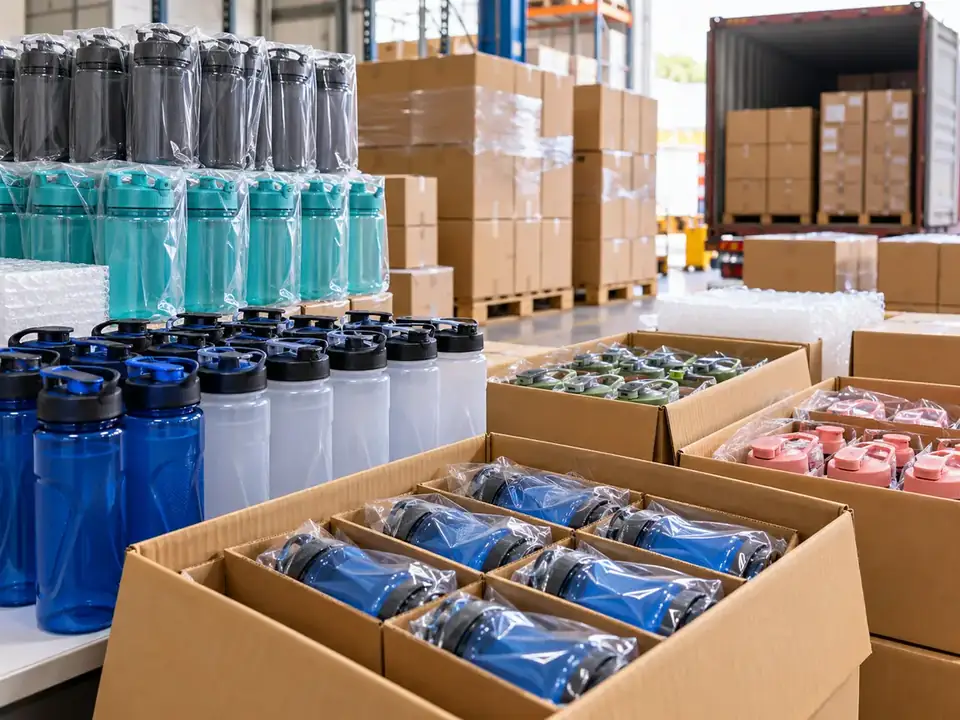
Reduce damage and freight surprises with practical master-carton, retail-label and documentation checks for bulk drinkware. These checkpoints focus on real sampling, documentation and commercial decisions for the exact plastic drinkware model.
- Approve retail package and accessories list
- Measure individual and master carton sizes
- Confirm protection of printed and clear surfaces
Decide whether the order is retail-ready or bulk
Retail gift boxes, printed sleeves and plain protective bags solve different commercial needs. Confirm if bottles are sold singly, in multipacks or unpacked for promotional assembly. Packaging design should consider the physical bottle, cap, carry handle, inserts and any separate accessories. A drawing that shows an empty bottle body without the actual cap can lead to costly carton fit errors.
Design packaging around real dimensions
Request packed individual size and the number of units per master carton, plus carton outer dimensions and gross/net weights. Taller bottles and large water jugs may waste carton space and change transportation cost. If a retail carton is included, check that it protects the protruding lid or handle. Confirm whether mixed colors or separate components affect carton counts.
Protect the finish, seal and decorative artwork
Printed logos and transparent plastic surfaces can scratch when bottles rub against each other. Evaluate sleeves, separators or paper-based protection based on the chosen product and route, not merely on stock packaging photos. Keep removable items such as shaker inserts in the agreed package. Test the proposed packing arrangement in samples so the unboxing contents match the approved bill of materials.
Validate shipping and warehouse handling
Carton strength, stacking patterns and moisture exposure vary across shipment modes and storage conditions. Agree on relevant testing and handling standards with the buyer or freight partner. For large lots, check palletization, carton marks and any retailer's warehouse labeling requirements. Do not quote a guaranteed shipping cost until dimensions, destination and service terms are clear.
Prepare documents and import-ready labels
Commercial invoice, packing list, HS classification and any certificates should match the product and shipment. Retail labels may require country-of-origin information, importer identification, warnings, volume, materials or local-language text depending on market. Confirm who prepares each document and who approves the final print file. Avoid assuming a group certificate or old customs code automatically applies to the current SKU.
Compare quotations at the same delivery term
EXW, FOB and other Incoterms place different tasks and costs on buyer and seller. Specify named place, logistics responsibility and export documentation expectations when requesting prices. For a second shipment, compare freight per packed unit as well as supplier price. Keep approved carton diagrams and labeling revisions for consistent repeat orders.
Buyer checklist
- Approve retail package and accessories list
- Measure individual and master carton sizes
- Confirm protection of printed and clear surfaces
- Review labeling and shipment documentation
- Compare freight with the same shipping term
Frequently asked questions
Can I mix bottle colors in one carton?
Possibly, if the production and warehouse plan supports it. Specify color breakdowns and carton labels so receiving staff can check the exact contents.
Does a lower carton count always lower freight cost?
No. The total packed volume, weight, route and charges determine shipping cost. Compare the packed shipment, not just pieces per case.
Need a quote for a specific model?
Send the model, expected order quantity, logo requirements and destination market. XUYI can review confirmed material and customization options.
Request a Plastic Bottle Quote →