An RFQ is not paperwork. It is the cheapest quality-control tool in the sourcing process: a precise brief helps suppliers quote the same product, exposes missing assumptions early and gives you a fair basis for comparing factories.
- Define the exact product type, capacity and intended use
- State body, cap and seal materials or ask for a recommendation
- Specify body and cap colors plus any Pantone matching requirement
Why vague RFQs produce bad quotes
A factory quotes what you describe. Describe only “water bottles with logo” and you may get the factory’s default body, cap, print method and carton. If your actual need is a Tritan body with a two-color logo in retail boxes, the attractive quote may be for a different product — and the real price appears later as a revision. Vague RFQs also make suppliers impossible to compare fairly: Factory A may price the cheap default, while Factory B prices what you actually intended. Precision removes those hidden assumptions and gives every supplier the same technical and commercial starting point.
The 12-line water bottle RFQ template
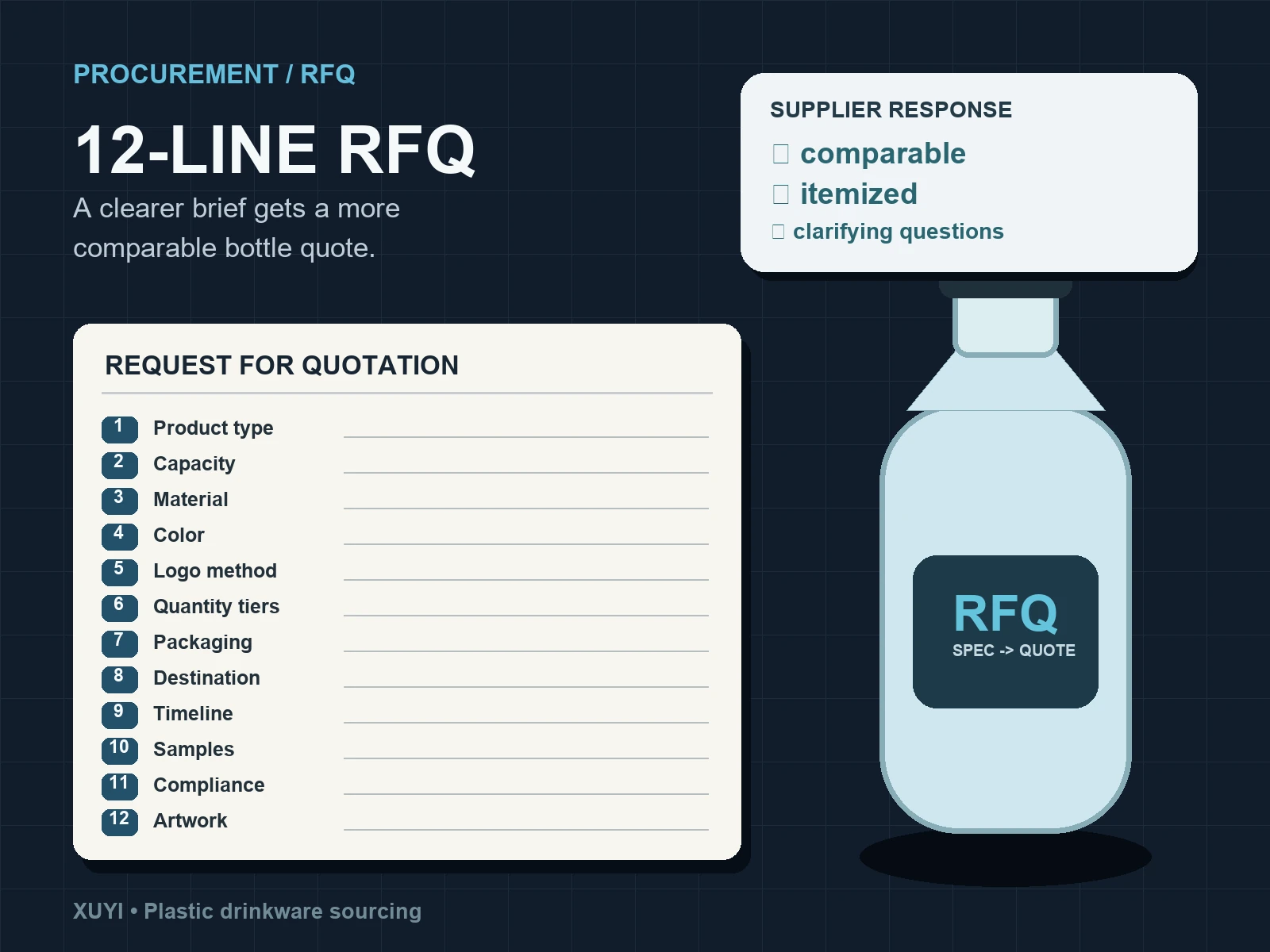
Copy and fill these twelve lines: 1. Product type — sports bottle, kids’ bottle, water jug or shaker, plus a model number or reference photo. 2. Capacity — exact ml or oz. 3. Material — Tritan, PP, PC, PETG, or ask the factory to recommend one for the use case. 4. Color — body, cap and any Pantone matching requirement. 5. Logo method — silkscreen, heat transfer, UV printing, embossed or none, plus color count, size and position. 6. Quantity tiers — for example 3,000 / 5,000 / 10,000 pieces. 7. Packaging — bulk polybag and export carton, individual retail box or custom printed packaging. 8. Destination — country and port, or the EXW/FOB/DDP basis you need quoted. 9. Timeline — the date goods must be ready to ship, not simply “ASAP.” 10. Samples — stock sample, logo mock-up or pre-production sample. 11. Compliance — applicable food-contact, labeling or market requirements. 12. Artwork status — vector files ready or design support required. If a field is unknown, mark it TBD and ask the supplier to recommend an option instead of leaving the factory to make an invisible assumption.
What happens after you send it
A good factory response should include unit prices at each quantity tier, tooling or setup fees separately, sample terms, packaging assumptions, production lead time and the trade term or freight basis used for the quote. The best responses also contain clarifying questions. A supplier who asks whether your Pantone reference is coated or uncoated, whether the logo is one or two colors, or whether you need EXW or FOB pricing is showing that it is actually reviewing the specification. A single unexplained lump-sum price may be faster, but it tells you much less about what is included.
The lines buyers skip — and pay for
Packaging, timeline and compliance are the three details buyers most often leave until late in the conversation, and they can cause the most expensive rework. Packaging discovered after the initial quote can mean a new carton price, box sample and production schedule. A late delivery requirement can force a different production slot or create rush costs. A late compliance requirement can be worse: goods may need additional testing, labeling or documentation before they can legally be sold in the target market. Put these constraints in the first RFQ so the supplier can price them and flag problems before you commit.
Send the same RFQ to three suppliers
Three suppliers is a practical starting point for a comparable sourcing exercise. Send the identical RFQ, artwork status, quantity tiers and packaging basis to each one. Compare like with like: the same material, capacity, cap, decoration, packaging, destination basis and requested delivery date. If a factory proposes an alternative, ask it to state the difference and commercial effect rather than silently substituting another configuration. The lowest number is useful only when you know it covers the same specification.
Turn the quote into an approved specification
Once you select a supplier, the RFQ becomes the starting point for sample approval and the purchase specification. Confirm the exact model, material, color, cap, logo artwork, packaging, quantity, destination terms and required documents. Where appropriate, approve a physical sample before mass production and keep the approved version as the reference for inspection and reorders. A strong RFQ does more than obtain a price: it creates a traceable record of what the supplier was actually asked to make, making later quality checks and repeat orders easier to control.
12-line RFQ template: what to send and what the factory should confirm
Use the same twelve fields for every supplier. The buyer column defines the requested basis; the supplier column makes assumptions, pricing and missing information visible before you compare quotes.
| RFQ line | Buyer should provide | Supplier should return or confirm |
|---|---|---|
| 1. Product type | Bottle family plus model number or reference photo | Exact model/configuration quoted |
| 2. Capacity | Exact ml or oz | Quoted nominal capacity and variant |
| 3. Material | Tritan, PP, PC, PETG or recommendation requested | Exact material/resin basis and any substitution |
| 4. Color | Body/cap colors and Pantone requirement | Stock/custom color feasibility and cost basis |
| 5. Logo method | Print/decoration method, colors, size and position | Method feasibility, setup fee and sample basis |
| 6. Quantity tiers | Two or three target quantities | Unit price at each tier and MOQ |
| 7. Packaging | Bulk, retail box or custom packaging | Packing configuration, carton basis and added cost |
| 8. Destination | Country, port or required Incoterm | Quoted trade term and freight assumptions |
| 9. Timeline | Ready-to-ship date | Production lead time and schedule constraints |
| 10. Samples | Stock, decorated or pre-production sample | Sample cost, lead time and approval requirement |
| 11. Compliance | Target-market standards, food-contact or labeling needs | Available evidence and testing/documentation scope |
| 12. Artwork status | Vector files ready or design support needed | Accepted file format and artwork/setup requirements |
Buyer decision criteria, not XUYI certification, published MOQ or guaranteed delivery times. Verify the exact model and market requirements.
Buyer checklist
- Define the exact product type, capacity and intended use
- State body, cap and seal materials or ask for a recommendation
- Specify body and cap colors plus any Pantone matching requirement
- Name the logo method, number of colors, size and position
- Give at least two or three quantity tiers
- State bulk or retail packaging requirements
- Give destination country and port or the required Incoterm basis
- Set a target ready-to-ship date rather than “ASAP”
- State whether a stock, decorated or pre-production sample is required
- Name the destination-market compliance or labeling requirements
- State whether vector artwork is ready or design support is needed
- Ask for itemized pricing, tooling/setup fees, lead time and assumptions
Frequently asked questions
How long should a water bottle RFQ be?
Twelve core lines are enough for a standard sourcing request when the product already exists. A new custom mold may need drawings, dimensions, 3D files, neck details or other technical documents. The goal is not maximum length; it is to remove the assumptions that materially change the quote.
Should I send the RFQ to multiple bottle factories?
Yes. Three suppliers is a practical starting point. Send the same RFQ, quantity tiers, artwork status and packaging basis to each one so differences in the returned prices are easier to explain.
Do I need to share my target price?
It can help when the target is tied to a defined quantity and specification. A factory can tell you whether the target is realistic and which specification changes would affect it. Keep the target separate from the required specification so the supplier does not assume you want a cheaper material or simpler package just to hit the number.
What if I do not know the material yet?
Say so explicitly: “Material TBD — recommend a BPA-free option for daily gym use, with dishwasher resistance preferred.” That invites the factory to recommend a suitable grade while keeping the decision visible instead of letting an unspecified material become an unspoken assumption.
Need a quote for a specific model?
Send the model, expected order quantity, logo requirements and destination market. XUYI can review confirmed material and customization options.
Request a Plastic Bottle Quote →