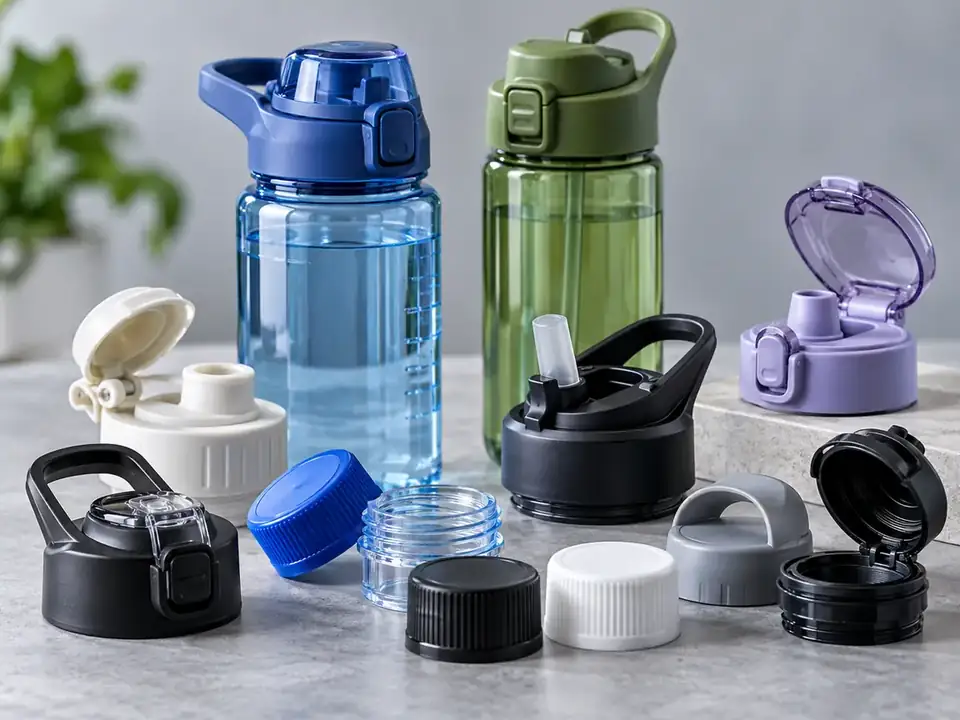
Buyers often obsess over bottle bodies and treat caps as an accessory. At bulk scale, the closure affects leak exposure, cleaning, user age range, spare-part demand and reorder compatibility. This guide compares five common water bottle cap types and shows what to lock in the RFQ before tooling.
- Define the primary user, age range and drinking behavior
- Confirm the exact neck finish and compatible cap models in writing
- Approve gasket, valve, hinge and locking details on the assembled sample
The five cap families buyers actually encounter
Buyers often focus on the bottle body and treat the lid as an accessory. At bulk scale, that is a mistake: the closure controls how people drink, clean the bottle, carry it and replace worn parts. The five common families are flip-top, straw, screw cap, sport spout and magnetic or auto-seal. Flip-top lids are the workhorse for sports bottles because they can usually be opened and closed with one hand; their main wear points are the hinge, locking feature and seal. Straw lids are convenient for children, school and desk use because the user can sip without tipping the bottle, but the straw adds a cleaning step and creates a replacement-part issue. Screw caps have the fewest moving parts and are usually the simplest choice when leak exposure and low cost matter more than one-hand drinking. Sport spouts suit cycling and gym use, but valve geometry and molding tolerance matter. Magnetic or auto-seal lids offer a premium user experience, yet they also contain more parts and normally cost more. The right choice is not the fanciest lid. It is the closure whose failure points, cleaning requirements and replacement plan match the use case.
Water bottle cap types: the practical comparison
The table below is a purchasing guide rather than a laboratory ranking. Leak performance depends on the actual neck finish, gasket, valve, molding quality, assembly and test conditions. A well-designed screw cap can outperform a poorly molded premium lid, while a convenient cap can still be the better commercial choice if the user needs one-handed access. Compare the complete bottle-and-cap assembly, not a loose cap sample. For bulk programs, also compare the cost of spare caps, straws and seals because the cheapest initial closure can create the most expensive after-sales workflow.
The bottle neck finish compatibility trap
Neck finish is the interface between the bottle body and its closure. It includes the thread or other engagement geometry plus the sealing surface, so two caps that look similar are not automatically interchangeable. This is where many reorder problems begin: a buyer launches 5,000 bottles with a flip-top, then asks for straw lids a year later and discovers that the original neck does not accept the new cap. If future cap variants are even a possibility, freeze the neck finish before tooling and have the supplier confirm in writing which closure families fit it. Ask for the neck drawing or dimensional specification, the exact cap model numbers and a physical fit check. Treat bottle neck finish compatibility as a specification, not a verbal promise.
Match the cap to the actual user and channel
Kids' bottles need a different closure brief from sports or office bottles. For roughly ages 3–8, straw lids can be attractive because they support sipping without lifting the bottle, but the buyer should plan for cleaning and replacement straws. For older school users, a flip-top can provide a simpler one-hand experience. Sports and gym programs usually favor flip-top or sport-spout designs where quick access matters. Office and commuter programs can favor screw caps because a simple threaded closure has fewer moving parts and can be easy to clean. Hiking and outdoor programs also benefit from simple closures when repair and spare-part access are limited. If you are evaluating the best cap for a kids water bottle bulk order, specify age range, drinking behavior, detachable parts and cleaning method before comparing colors or decoration.
What to verify before approving the cap
Cap approval should happen as part of the finished bottle sample, not as a separate accessory review. Ask how many opening and closing cycles the hinge, valve or button is designed to tolerate, but do not turn a supplier's internal target into a marketing guarantee without agreed testing. Inspect gasket seating, thread engagement, lock action and any moving components. If the product will be dishwashed, test the complete closure under the intended cleaning conditions rather than testing only the bottle body. For leak evaluation, define the liquid, orientation, temperature, duration and pass/fail rule before production. Finally, ask whether caps, straws and seals can be purchased separately, what the replacement MOQ is and whether future orders will use the same neck and component specification.
Keep the first launch simple
One cap-body combination is usually easier to qualify than five variants at launch. Each additional lid creates another SKU, another spare-parts line, another cleaning instruction and another set of customer expectations. Start with the closure that best fits the primary channel, then use reorder data and complaint patterns to decide whether a second cap is justified. When you do add a variant, keep the neck finish and compatible components documented so marketing can change the lid without forcing a new bottle mold. A disciplined cap strategy reduces leakage complaints, avoids compatibility surprises and makes repeat purchasing much easier.
Cap approval matrix: lock the closure before the PO
At bulk scale, closure choice affects usability, leak exposure, cleaning and after-sales parts. Use this matrix to turn a cap preference into a measurable purchasing specification.
| Check | Lower-risk starting point | Question for the RFQ |
|---|---|---|
| Cap mechanism | One clearly identified cap model with approved assembled sample | What exact cap model is quoted, and what parts are included? |
| Neck finish | One documented neck finish with named compatible caps | Which flip-top, straw, screw, sport-spout or magnetic caps fit this neck? |
| Sealing | Gasket or valve geometry checked on the finished bottle | What sealing surfaces are used, and how is seal fit inspected? |
| Durability | Cycle and cleaning conditions agreed before production | What opening/closing and dishwasher conditions should the sample pass? |
| Spare parts | Caps, straws and seals available separately where the channel needs them | What are the replacement MOQ, lead time and part numbers? |
Buyer decision criteria, not XUYI certification, published MOQ or guaranteed delivery times. Verify the exact model and market requirements.
Buyer checklist
- Define the primary user, age range and drinking behavior
- Confirm the exact neck finish and compatible cap models in writing
- Approve gasket, valve, hinge and locking details on the assembled sample
- Specify leak, cycle and cleaning tests before bulk production
- Confirm spare-cap, straw and seal availability plus replacement MOQ
Frequently asked questions
Which cap leaks the least?
There is no universal winner independent of design. A correctly molded screw cap has few moving parts and can offer very low leak exposure, while convenient caps can also perform well when their seals, valves and neck interface are correctly designed. Compare the complete closure system under agreed test conditions rather than relying on the cap category alone.
Can I switch cap types on the same bottle later?
Only if the neck finish and sealing interface were designed for the alternative cap. Confirm the compatible cap family before tooling and keep the neck drawing, cap model number and approved fit sample in the purchase specification.
Are straw lids suitable for children's bottles?
They can be a practical choice for the intended age group, but buyers should consider cleaning, detachable parts, straw durability and replacement logistics. Do not use a generic age claim; confirm the product and destination-market requirements for the actual design.
How many cap options should I offer at launch?
Usually one well-qualified cap is the simplest starting point. Multiple closures increase SKU count, spare-parts inventory, packaging variants and approval work. Add another cap after the first configuration proves demand or when a channel clearly requires it.
Need a quote for a specific model?
Send the model, expected order quantity, logo requirements and destination market. XUYI can review confirmed material and customization options.
Request a Plastic Bottle Quote →