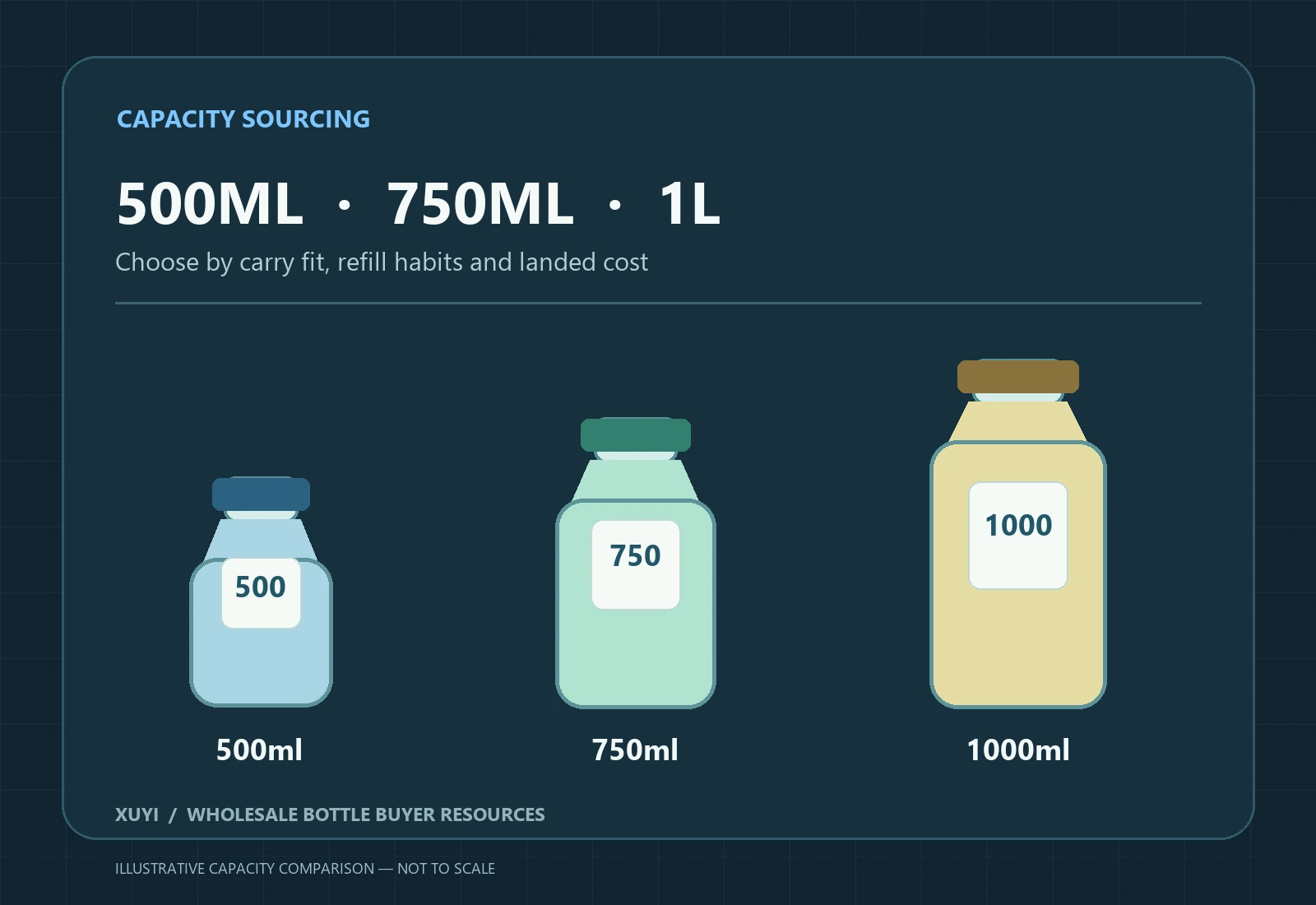
A buyer asks which size will sell best and gets a predictable answer: the biggest-looking bottle in the catalog. But a 1-liter body is not automatically the strongest product for a commuter, child or conference attendee. Capacity is a use-case decision with consequences for shelf space, carton cube, carrying comfort and repeat sales. This guide compares common size tiers without confusing marketing labels with measured volume.
- Define user, context and realistic refill intervals
- List maximum acceptable filled weight and physical dimensions
- Compare verified 500ml, 750ml and 1000ml catalog models
Start with the user's refill pattern
The right size depends on when and where people refill. A commuter with easy access to water may care more about a bottle fitting a bag. A gym user may value fewer interruptions. A school program has additional constraints around carry weight, access and age-appropriate closures. Before choosing a bottle, ask about the longest typical interval between refills, whether the bottle is used on the move and the bag or holder it must fit. Do not use capacity alone as a substitute for a user study or product trial.
500ml: the compact default for daily carry
A 500ml bottle can suit giveaways, meetings, short commutes and customers who prioritize portability. It tends to be easier to place in backpacks or retail displays than an oversized bottle, although actual dimensions and shape determine fit. Evaluate whether the opening and lid suit one-handed drinking or desk use, and check the real product weight when filled. For a catalog comparison, review a verified 500ml sports-bottle model rather than assuming every compact-looking product has the same material or cap. For a source-listed 500ml option, check the dimensions and body configuration of 500ml sports bottle model 2095 rather than assuming every half-liter bottle fits the same holder.
750ml: a middle option with different trade-offs
A 750ml bottle increases carrying volume without moving straight to the largest format. It may suit school, office or recreational programs when refill frequency is moderate. That does not make every 750ml product appropriate for children: cap design, cleaning access, strap geometry, age recommendations and the filled weight still need separate evaluation. If the buyer wants more capacity but worries about returns from oversized products, a sample of the mid-size option is a useful comparison point. A catalog-listed 750ml comparison point is 750ml kids bottle model 2106; its child-oriented positioning does not remove the need to check the intended age group.
1L: more capacity, more questions about fit
A nominal 1000ml bottle can be attractive for exercise, outdoor sessions or desks where refilling is inconvenient. It also occupies more pack and carton volume, and may not fit a particular car cup holder, bike cage or narrow backpack pocket. Test a real sample with the target accessories rather than promising universal fit. Confirm the cap's usability when the bottle is full and heavier. A 1L choice should solve the user's actual refill problem, not merely create a larger product photograph. Use 1000ml sports bottle model 2212 to compare a documented 1000ml sports bottle with the smaller formats, including actual packed dimensions.
Capacity labels need a measurement basis
A printed 32 oz or 40 oz marketing label is not necessarily an exact conversion of the factory's milliliter value. Ask whether the number represents nominal fill capacity, total brimful capacity or a market size class; record the actual source capacity in ml and describe any approximate size class explicitly. For a bottle sold in multiple sizes, confirm the exact configuration shown in the artwork and on the master carton. Do not turn catalog or market rounding into a promised measured volume.
Why capacity changes freight and landed cost
More volume generally changes the physical envelope of the bottle, but shipping cost depends on the packed dimensions, nesting possibilities, carton count, tare weight and the transport method. A 750ml bottle with a bulky carry handle can use more carton cube than a simpler 1L design. Ask for master-carton dimensions and gross weight for each exact model and run a like-for-like freight calculation. Your decision should consider selling price, handling, damage risk and inventory turnover, not factory unit price alone.
Pilot sizes before multiplying SKUs
For a first private-label launch, select one primary size that matches the intended user and distribution channel, plus perhaps one alternative for testing. Approve physical samples and a common comparison sheet covering dimensions, cap operation, artwork area, packaging and landed cost. Do not automatically launch the same design in three capacities: each size can affect mold availability, color MOQs, carton count and replacement-part compatibility. Expand after sales or buyer feedback identifies demand for a second format.
Capacity comparison for wholesale bottle buyers
These are application-fit prompts, not universal rules. Verify physical size, filled weight and actual source capacity on the exact selected model.
| Size tier | Typical sourcing advantage | Verification before ordering |
|---|---|---|
| 500ml | Compact positioning for short outings, gifts or daily carry | Actual height, diameter, cap and filled weight |
| 750ml | Middle capacity when users have moderate refill access | Age/use fit, dimensions and sealing access |
| 1000ml (1L) | Higher capacity for exercise, outdoor or desk programs | Bag/holder fit and packed carton cube |
| Multiple capacities | Potential range extension after proven demand | Different toolings, caps, cartons and SKU costs |
| Approximate oz class | Familiar merchandising language for some markets | Do not equate rounded label with exact US fl oz |
| Freight comparison | True landed-cost view across choices | Carton count, cube, weight and shipping term |
Buyer decision criteria, not XUYI certification, published MOQ or guaranteed delivery times. Verify the exact model and market requirements.
Buyer checklist
- Define user, context and realistic refill intervals
- List maximum acceptable filled weight and physical dimensions
- Compare verified 500ml, 750ml and 1000ml catalog models
- Confirm nominal versus brimful volume and any oz size class
- Test lid operation and usability at full weight
- Measure fit with target bags, holders or retail fixtures
- Request packed carton dimensions and gross weight per size
- Compare landed cost instead of unit cost alone
- Confirm logo area and packaging for each actual size
- Pilot the best-fit format before expanding the range
Frequently asked questions
Is 750ml better than 500ml for school or office orders?
Neither is universally better. 750ml reduces refill frequency, while 500ml can be easier to carry. Consider users, filled weight, cap design and the actual product dimensions.
Does 1000ml equal 32 US fluid ounces exactly?
No. A 1000ml capacity is about 33.8 US fluid ounces; a 32 oz marketing size class must not be presented as an exact conversion. Keep factory ml and approximate class distinct.
Does a bigger bottle always cost more to ship?
Not necessarily on a per-piece basis. Packed shape, nesting, carton quantity, gross weight and freight method can matter more than nominal liquid capacity. Compare actual packed data.
Should one bottle line have all three capacities?
Only when buyer demand justifies the additional SKUs and each configuration has been sampled and priced. One well-matched launch size is often simpler to replenish and support.
Need a quote for a specific model?
Send the model, expected order quantity, logo requirements and destination market. XUYI can review confirmed material and customization options.
Request a Plastic Bottle Quote →