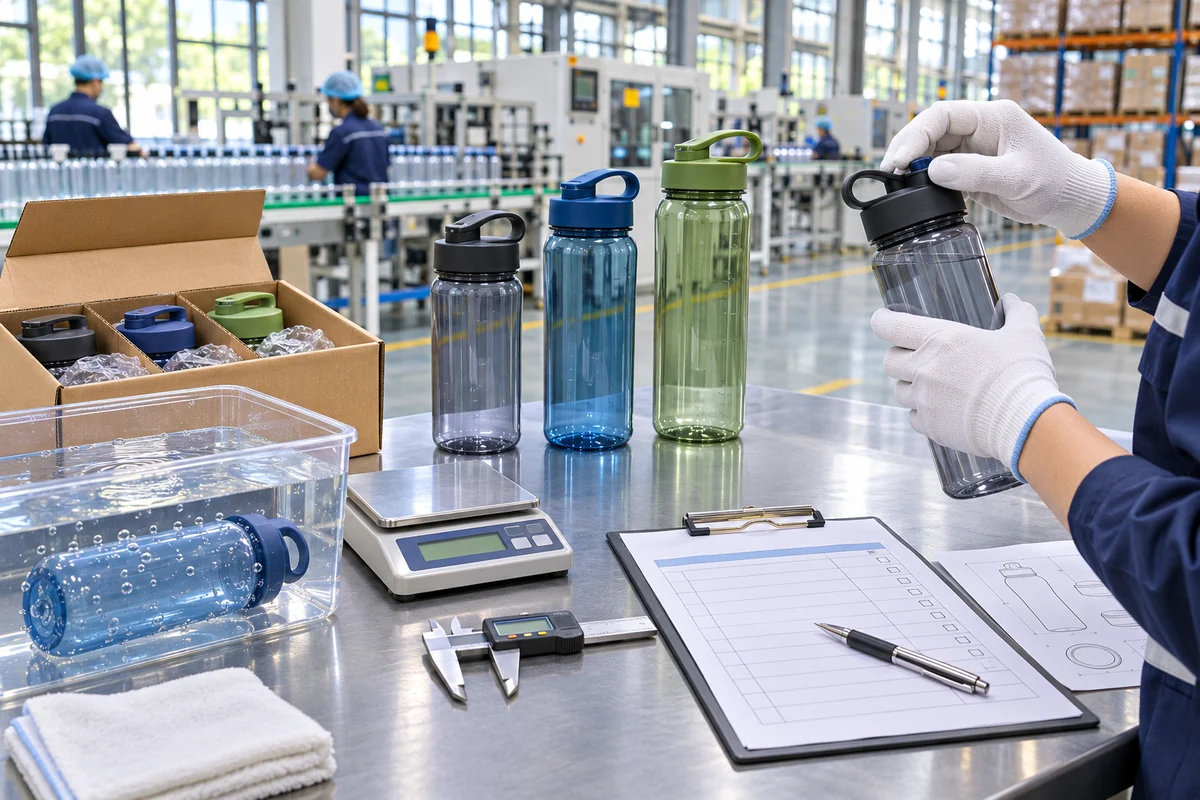
The most expensive quality problem is often created before production starts: a buyer approves a name, image or chat description instead of a controlled sample and specification. This checklist gives importers, distributors and brand owners a practical sequence for wholesale plastic water bottle approval. It covers model identity, 380–800ml / 12.8–27 oz capacity references, PC / PP / ABS material records, lid fit, color, logo artwork, packing and retained samples. The buying decision should be recorded at SKU level so the approved material, capacity, color, closure, decoration and packing condition can be repeated without relying on a generic product name.
- Write the exact model and capacity in ml and approximate oz.
- Measure the sample and photograph the setup.
- Check lid fit, gasket, opening and repeatable inversion performance.
1. Lock the model and source record
Start with the exact factory model, not a generic image. Record the model number, product route, source image, current D1 record and intended sales description. Model 2090 is listed as a 550ml / approximately 18.6 oz plastic sports bottle, while Model 2401 is listed as 650ml / approximately 22 oz. Put the selected model and color variant on the quotation and sample request. If a record says component allocation is not specified in the source, keep that uncertainty visible until the factory confirms it. Start the QA record with the exact SKU: body, cap, gasket, accessory, material, capacity in ml and approximate oz, color and decoration. A generic model name is not enough for mass-production release.
2. Measure capacity and dimensions
Fill the sample with a controlled measure and compare the result with the source-listed capacity. Keep millilitres as the manufacturing reference and show approximate ounces only as buyer-facing support. Check height, diameter, base stability and logo space. A 500ml bottle should not be treated as interchangeable with a 550ml bottle. For records such as 770ml / 850ml, identify the capacity on every sample, drawing and carton. Photograph the measurement setup and keep it with the approved sample. Use the same sample identity for appearance, dimension, closure, leak, decoration and packing checks. Mixing samples from different variants makes a pass result impossible to audit.
3. Check lid fit and leak resistance
Inspect the lid, thread, gasket, mouth opening, carry loop and any spout as a system. Perform a repeatable fill-and-invert check on approved samples and record duration and conditions; do not turn one desk test into a guaranteed leak-proof claim for an entire run. Check opening, closing and handle comfort in the intended use position for sport, school, travel or hospitality. Write the test condition beside the result: sample size, method, duration, orientation, temperature or handling condition and the failure rule. Do not turn an observed condition into a universal claim.
4. Verify plastic components and finish
Match the physical sample to the written material record. XUYI records include PC, PP and ABS combinations, including examples where a PP lid and PC body are stated. Check for sink marks, sharp edges, flash, stress whitening, uneven wall appearance and inconsistent translucency. If a buyer requires a regulatory or food-contact position, request documents for the exact material and production lot. Never infer certification from a photo or acronym. Record defects by type and location, then link the corrective action to the responsible component or process. This gives the factory and buyer a measurable follow-up instead of a general rework request.
5. Approve color, logo and decoration
Review color under a consistent light source and compare the bottle with the approved artwork. Record whether color is standard or custom and note where gradients need confirmation. Logo approval should cover position, scale, orientation, method and tolerance. Ask for a decorated sample. A digital proof checks layout but cannot prove how ink, coating or transparency will look on the curved plastic surface. Check the printed artwork, color reference, surface finish and barcode against the approved file. A product can pass the mechanical check while still being commercially wrong for the buyer.
6. Validate packaging and carton data
Record inner protection, individual box requirement, pieces per carton, carton dimensions, shipping marks and pallet assumptions. Source records show different pack quantities across models; Model 2090 is listed at 60 pcs/carton while large water jugs use other formats. Confirm product, capacity and carton are the same version. Request a packed sample when the order enters a retail or distribution network. Before release, confirm carton quantity, inner protection, carton marks, mixed-color rule and destination. Packaging is part of quality when it can change damage, receiving or variant identification.
7. Separate inspection from certification claims
An inspection checklist can confirm whether a delivered sample matches an agreed specification; it does not create a legal certificate. Keep commercial checks separate from market compliance requirements, testing reports and claims. If evidence is not available, use careful wording such as subject to documentation review rather than a definitive safety or certification statement. Keep the signed sample record, photos, failed-unit disposition and change history for the reorder. The next inspection should compare the same acceptance rule and clearly show any approved change.
8. Set the mass-production release gate
Write a release record naming model, capacity, material allocation, color, logo artwork, packaging, carton data and inspection method, with date and version. A new resin, lid tooling, color formula, artwork, carton or capacity variant should not silently pass under the old approval. Keep the acknowledged record with the purchase order. Escalate repeated defects by SKU and component rather than hiding them in a total pass rate. The buyer needs to know whether the issue is isolated, variant-specific or a process trend.
9. Keep a retained reference sample
Keep one clean reference sample with the buyer and ask the factory to retain a matching reference. Store photos, measurements, artwork and carton information together. When a reorder arrives, compare the delivered sample before release to stock. Classify differences as acceptable, corrected or requiring buyer approval. A retained reference means both parties discuss the same physical object. Use the checklist as a release gate, not as marketing copy. A model is ready only when the specified sample, test condition, decoration and packing record are all closed.
Buyer checklist
- Write the exact model and capacity in ml and approximate oz.
- Measure the sample and photograph the setup.
- Check lid fit, gasket, opening and repeatable inversion performance.
- Confirm PC, PP or ABS component allocation and finish.
- Approve physical color and decorated artwork.
- Match product version to carton quantity and dimensions.
- Separate inspection evidence from legal certification claims.
- Record the production release gate and change-control rule.
- Retain a buyer sample and factory reference sample.
Frequently asked questions
What is the first QA check for a wholesale plastic bottle?
Lock the exact model and source record first. A generic image or product name is not enough because similar bottles can have different capacities, lids, materials and carton data.
Should one sample leak test create a leak-proof claim?
No. A repeatable sample check is useful evidence, but a claim should match the agreed test method, production controls and market requirements.
Does a factory inspection replace certification?
No. Inspection verifies an agreed product condition. Certification, testing and regulatory evidence must be reviewed separately for the exact material, variant, market and lot.
What should be recorded before reordering Wholesale Water Bottle QA Checklist: 9 Checks Before Mass Production?
Keep the approved sample identity, artwork version, carton and packing record, acceptance conditions, open changes and return reasons. A reorder should use that record rather than a generic model name.
Need a quote for a specific model?
Send the model, expected order quantity, logo requirements and destination market. XUYI can review confirmed material and customization options.
Request a Plastic Bottle Quote →