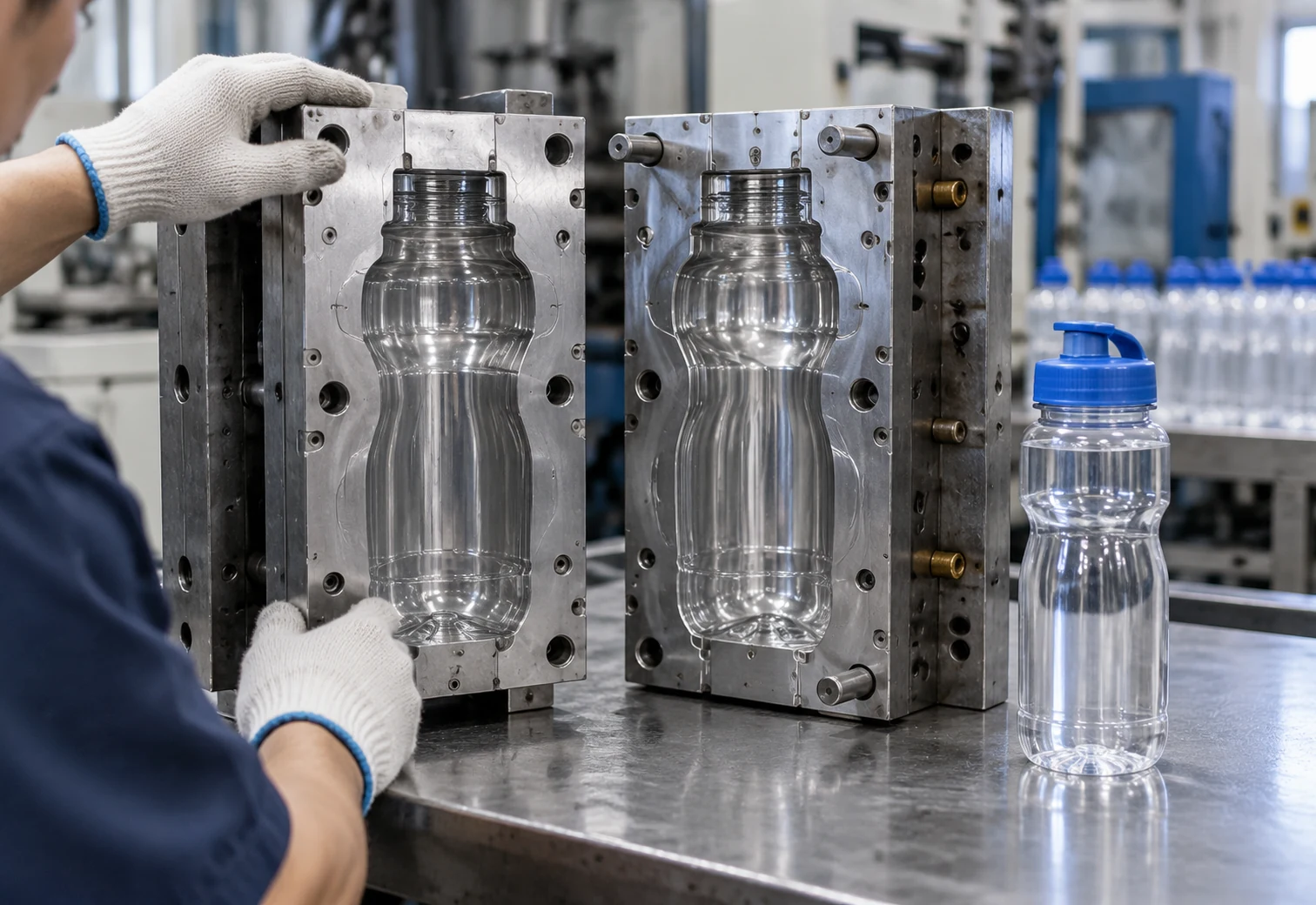
A custom bottle project can mean choosing an existing model, adapting a current tool or commissioning a new mold. Those options have different cost drivers, approval steps and ownership implications. A quote that lists only a mold fee and a unit price leaves important questions unanswered: what design is included, how many trial rounds are covered, who controls the tool, and what happens if the project changes. This guide helps buyers scope the tooling decision before paying a deposit. It does not promise a standard price or lead time; both depend on the actual design and factory quotation.
- Ask whether an existing tool can meet the real product requirement
- Compare existing, modified and new-mold options separately
- Request itemized tooling, trial, revision and maintenance costs
Decide whether you need an existing, modified or new mold
Start by separating visual preference from a real functional requirement. An existing bottle may already meet the capacity, grip and closure needs, leaving only color, printing or packaging changes. A modified tool may be feasible when a limited feature can be changed without compromising the rest of the design. A fully new mold is more relevant when the shape, neck, wall geometry or integrated details cannot be achieved with available tooling. Ask the supplier to identify which route is being quoted and what differences remain between your drawing and the nearest existing model. Compare the catalog details for sports bottle model 2100 before requesting a new shape; an existing model may answer the brief without new body tooling.
Understand the main drivers behind a tooling quote
Mold cost depends on the shape and dimensions, material and construction of the tool, number of cavities, surface finish, parting lines, cooling and ejection design, tolerances and the number of components. A bottle body, cap, handle, insert or accessory may require separate tooling or different production processes. Complex undercuts, special textures and tight appearance requirements can add engineering and trial work. Request an itemized quotation with design review, mold manufacture, trial shots, sample preparation, revisions and any transport or storage charges separated. Avoid relying on a generic online price range as if it were a binding quote.
Compare tooling cost with unit price and total project cost
A lower unit price does not automatically make a new mold economical, and an existing mold does not make every order cheaper. Compare the total project: tooling, per-piece price at realistic volume tiers, color or printing setup, packaging, sample fees, rejected-trial revisions, maintenance and freight. Ask for the assumptions behind any amortization calculation, including the volume over which tooling is spread and whether future orders use the same tool without extra charges. If the project may start with a small pilot and scale later, request both the initial cash requirement and the expected reorder cost under clearly stated conditions. Use shaker bottle model 5247 as a separate existing catalog reference when comparing body and closure needs; do not assume it shares tooling with another model.
Define trial samples and approval gates before cutting steel
Before mold manufacture begins, approve the drawing, dimensions that matter, neck and closure interface, surface finish, logo treatment and any known limitations. Ask which trial stages are included and what constitutes an acceptable sample. A first molded sample may reveal shrinkage, warpage, wall-thickness variation, draft or assembly issues that need adjustment. Agree how many review rounds are included, how additional changes are priced and who signs off each revision. A digital rendering can communicate appearance, but it cannot replace a physical sample when fit, grip, sealing or production finish must be assessed.
Put tool ownership, access and maintenance in writing
The purchase order should state who owns the physical mold after payment, where it will be stored, who may authorize production, how maintenance is recorded and what happens if the supplier relationship ends. Clarify whether the tool is dedicated to your project, whether another customer may use it, who pays for repairs, and how a transfer to another qualified factory would work. Keep this contract question separate from patent, design or trademark rights: paying for tooling does not by itself resolve every intellectual-property issue in every jurisdiction. Obtain qualified legal advice for material commercial or IP risks.
Plan for mold life, wear and future design changes
Ask what maintenance the tool needs, which wear parts are replaceable, how storage conditions are managed and how the factory records cycles or repairs if it tracks them. Do not accept an unsupported promise of a fixed mold life without the tool specification and operating assumptions. Changes to the bottle body, neck finish, cap fit, texture or dimensions may require engineering review and can affect compatibility with existing parts. Use revision numbers for drawings, approved samples and tool records so a reorder does not silently revert to an earlier design. Agree whether a change creates a new tool, an insert or only a process adjustment. Record the selected revision of sports bottle model 2310 in any comparison file so the approved reference is not confused with a later design change.
Build a tooling RFQ that can be compared across factories
Send the same drawing or reference model, intended capacity, key dimensions, neck and cap requirements, surface finish, target material, annual or initial quantity estimate and destination to every factory. Ask each bidder to quote existing-tool, modified-tool and new-tool options where practical, with the inclusions and exclusions listed. Request a milestone plan, sample acceptance criteria, ownership and transfer terms, maintenance responsibilities and unit prices at comparable quantities. If a supplier cannot yet confirm a number, ask what drawing, sample or engineering input is missing. A transparent list of unknowns is more useful than a fast but assumption-heavy quotation.
Reference on design rights and ownership
Patent and design rights are legal rights that differ from the physical mold itself. Buyers should document the tool's ownership, permitted use, storage and transfer in the supply agreement, and review intellectual-property issues separately.
Practical next step: Put the physical tool terms in the quotation and contract, and seek qualified legal advice for jurisdiction-specific rights.
Primary references
External regulations and standards are independent references, not product certification or proof of testing by XUYI. Confirm applicability and the latest rules for the exact product, destination and transaction date.
Custom mold quotation: compare scope before price
Use the same requirements with each supplier so the quote difference reflects a real difference in tooling or project scope.
| Decision item | Quote must state | Buyer approval check |
|---|---|---|
| Tooling route | Existing tool, modification or new mold | Does the route satisfy the required shape and function? |
| Mold construction | Cavities, components, finish and key design assumptions | Are inclusions and exclusions itemized? |
| Trial and samples | Trial stages, sample rounds and revision charges | What is the acceptance gate for each stage? |
| Unit price | Quantity tiers and amortization assumptions | Are volumes and setup costs comparable? |
| Ownership and access | Owner, storage, use, maintenance and transfer terms | Can the tool be retrieved under stated conditions? |
| Change control | Revision process and cost responsibility | What changes require a new tool or new approval? |
Buyer decision criteria, not XUYI certification, published MOQ or guaranteed delivery times. Verify the exact model and market requirements.
Buyer checklist
- Ask whether an existing tool can meet the real product requirement
- Compare existing, modified and new-mold options separately
- Request itemized tooling, trial, revision and maintenance costs
- Define the drawing revision, neck interface and finish before tooling
- List sample stages, approval criteria and included review rounds
- Separate tooling charges from unit price and amortization assumptions
- State physical tool ownership, storage, access and transfer rights
- Assign responsibility for maintenance, repairs and wear parts
- Use revision control for drawings, samples and production changes
- Compare factory quotations using the same scope and quantity assumptions
Frequently asked questions
Can a supplier quote a reliable mold price from a reference photo?
A photo may support an initial discussion, but a dependable quote usually needs dimensions, design intent, material, neck and closure details, finish requirements and an agreed scope. Ask which assumptions remain open.
Is using an existing mold always cheaper?
Not necessarily. It can avoid a new tooling charge, but the available model may require compromises or additional decoration and packaging. Compare the complete project and verify that the existing design fits the brief.
If I pay for the mold, do I automatically own all design rights?
No universal answer applies across all contracts and jurisdictions. State physical tool ownership and use/transfer rights in writing, and address patents, designs, drawings and trademarks separately with qualified legal advice.
What should be included in the quoted lead time?
Ask the factory to separate drawing review, tool manufacture, trial sampling, buyer review, revisions and production. Confirm the starting event, dependencies and what delays require a revised schedule rather than relying on a single unqualified date.
Need a quote for a specific model?
Send the model, expected order quantity, logo requirements and destination market. XUYI can review confirmed material and customization options.
Request a Plastic Bottle Quote →