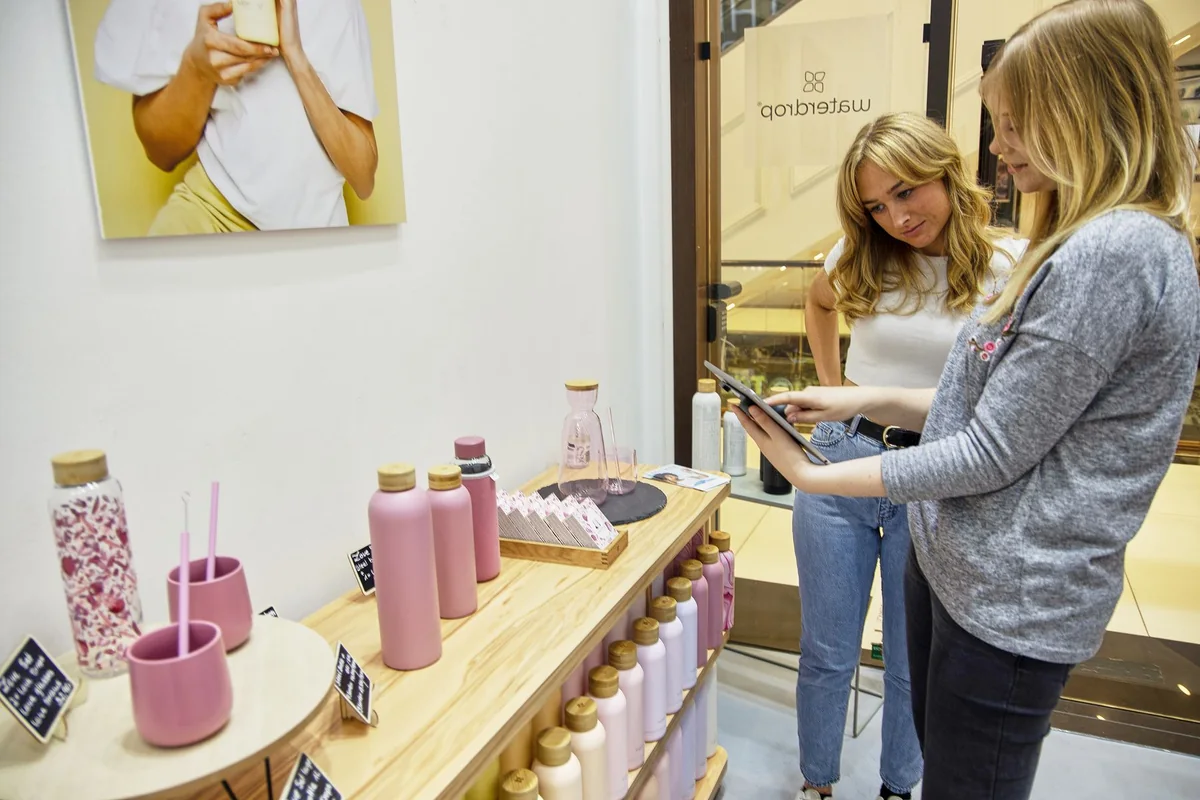
Homeware and lifestyle stores need a repeatable retail assortment, not just one photogenic bottle. This procurement guide covers customer segments, usable shelf space, sample approval, clear claims, color quantities, landed margin and replenishment. Its licensed shop photograph is an illustrative retail setting, not a XUYI customer or specific model.
- Confirm: Separate commuter, home and gift customers before choosing SKUs
- Confirm: Build a small tested assortment of body and closure formats
- Confirm: Test retail shelf spacing, labels and customer handling
Separate commuter, home and gift customers before choosing SKUs
Start with actual sales or comparable store demand rather than an attractive mood board. Separate commuter bottles, everyday household use, impulse gifts and outdoor accessories because different buyers need different size cues, carrying options and price expectations. Record realistic shelf facings, target ticket prices and likely peak seasons. A small pilot in representative stores gives a better first buy than splitting a high-volume order evenly across every proposed color. Create a documented demand sheet separating confirmed quantities from forecasts, owner approval and a small justified buffer. Recheck the allocation when the first pilot closes; a named buyer should sign off the quantities before deposits or artwork commitments. Review model 2030 as a physical reference before approving this variant; confirm its current product record rather than assuming the same material or cap configuration.
Build a small tested assortment of body and closure formats
Ask for a short list of assembled bottle-and-lid combinations that match each retail use. Compare handling with the lid installed, mouth opening, height, base, ease of carrying and the actual materials documented for each assembly. A shape on a mood board is not an approved production configuration. Keep unfamiliar lid types and replacement-part options as samples until the retailer has tested cleaning and consumer instructions with actual units. Record a physical fit-and-use test including the assembled closure and all removable parts. Keep a dated sample photograph, the exact revision and a clear list of assumptions that were not yet proven by supplier documents. Review model 2059 as a physical reference before approving this variant; confirm its current product record rather than assuming the same material or cap configuration. Consider XUYI model 2402 only as a catalog reference at this decision stage; request its complete physical sample and verify the configuration rather than inferring it from the editorial photograph.
Test retail shelf spacing, labels and customer handling
Mock up a real gondola, end cap or lifestyle display with the packed sample. Measure shelf height and depth, stability, label visibility, barcode location and room for customers to lift a bottle without knocking over adjacent units. Photograph each approved planogram with its exact variant code. A picture of shoppers evaluating bottles illustrates the retail decision, but neither verifies XUYI supplied the pictured merchandise nor proves a specific unit fits your store. Use real measurements, signed labels and multiple sample units instead of applying one generic fit claim to all variants. The shop or operator must approve how bottles are stored and handled in its actual environment.
Approve real samples and document materials and care
Review the complete physical sample: bottle body, lid, seal, removable straw if any, instructions, retail label and packaging. Ask the supplier for evidence appropriate to the exact material assembly and the destination market; avoid claiming any product is universally leakproof, dishwasher safe or certified without matching records. Have store staff test opening, reassembly and cleanability. Keep signed sample photographs and a revision number linked to the purchase order. Review care instructions and relevant documented material information for the whole configured bottle. Claims such as dishwasher safe, BPA free or guaranteed leakproof require evidence appropriate to the precise model and destination. Consider XUYI model 2501 only as a catalog reference at this decision stage; request its complete physical sample and verify the configuration rather than inferring it from the editorial photograph.
Control private-label artwork and color-by-color order quantities
Keep blank retail stock separate from private-label designs. Confirm permission for each store brand, approved print position and color proof on a physical sample, not a monitor mock-up. Split the purchase order by SKU, cap configuration, color and artwork revision; ask which splits trigger separate minimum quantities or setup charges. Label every carton accordingly so merchandising staff can maintain the display without mixing versions. Obtain written art rights, inspect a printed sample and reconcile each carton label to an approved model and variant. Any changed logo, color, cap, packaging or supplier component needs a controlled purchase specification update.
Model landed gross margin and realistic slow-stock exposure
Calculate price and margin from the delivered, saleable retail unit, not an isolated ex-factory quotation. Include decorated units, gift packaging, barcode work, master cartons, sampling, inspection, duties, freight and the cost of moving cartons to individual stores. Scenario-test slower sell-through of an unpopular color and a limited promotion. Set reorder points using observed weekly sales and verified lead times rather than optimistic seasonal demand. Compare equivalent offers on total delivered usable-unit cost and explicitly identify freight responsibility, carton quantities, duty assumptions, sampling and make-good procedures. Document the date at which a revised quote must be approved. Consider XUYI model lo-001 only as a catalog reference at this decision stage; request its complete physical sample and verify the configuration rather than inferring it from the editorial photograph.
Receive shelf-ready cartons and plan data-led replenishment
At receipt, verify carton counts and cross-check retail labels, colors and closures against signed samples before items go on display. Test a sample from multiple cartons for cap presence, visible damage and barcode scanning; isolate any unexpected substitution. Keep a store-level count of received, displayed, sold, returned and damaged units. Feed return reasons and actual weekly sales into the next purchase order rather than adding untested colors automatically. At receipt, take a documented sample from several cartons, reconcile missing and damaged units and hold discrepancies separately. Preserve the approved sample, purchase order, receiving record and quality notes for a compliant repeat order.
Homeware Retail Drinkware Buying buyer approval matrix
Sign off each decision with actual physical samples, records and responsible people; never infer SKU performance from the contextual photograph.
| Stage | Required evidence | Buyer sign-off |
|---|---|---|
| Separate commuter, home and gift customers before choosing SKUs | Demand forecast and allocations | Approve quantity |
| Build a small tested assortment of body and closure formats | Signed complete physical sample | Approve assembled sample |
| Test retail shelf spacing, labels and customer handling | Actual fit and use notes | Approve scenario |
| Approve real samples and document materials and care | Assembly care and material evidence | Approve procedure |
| Control private-label artwork and color-by-color order quantities | Logo proof and variant quantities | Approve artwork |
| Model landed gross margin and realistic slow-stock exposure | Equivalent landed-cost quotation | Approve commercial terms |
Buyer decision criteria, not XUYI certification, published MOQ or guaranteed delivery times. Verify the exact model and market requirements.
Buyer checklist
Use these points when comparing a factory sample, artwork approval and purchase quotation.
- Confirm: Separate commuter, home and gift customers before choosing SKUs
- Confirm: Build a small tested assortment of body and closure formats
- Confirm: Test retail shelf spacing, labels and customer handling
- Confirm: Approve real samples and document materials and care
- Confirm: Control private-label artwork and color-by-color order quantities
- Confirm: Model landed gross margin and realistic slow-stock exposure
- Confirm: Receive shelf-ready cartons and plan data-led replenishment
- Retain printed sample sign-off
- Reconcile carton allocation by variant
- Record reorder approval and lead-time evidence
Frequently asked questions
Is the cover photograph an exact XUYI SKU or buyer installation?
No. It is a commercially licensed illustrative scene; the physical XUYI product assembly must be approved separately.
Can this category be advertised as leakproof, food-safe or dishwasher-safe without tests?
No. Obtain appropriate evidence for the exact bottle, cap, material and destination market before making a product claim.
Does one bulk quote cover all logo and color combinations?
Not necessarily. Confirm permissions, variant-level minimum quantities, physical proofs, setup charges and carton labeling.
What evidence should be retained before reordering?
Keep signed assembly samples, exact SKU, caps and seals, artwork version, quotes, carton records and receiving discrepancies.
Need a quote for a specific model?
Send the intended model, material requirements, expected order quantity, artwork and destination market. We will review the options for that exact product rather than assume one specification fits every bottle.
Request a Plastic Bottle Quote →Related Buying Guides
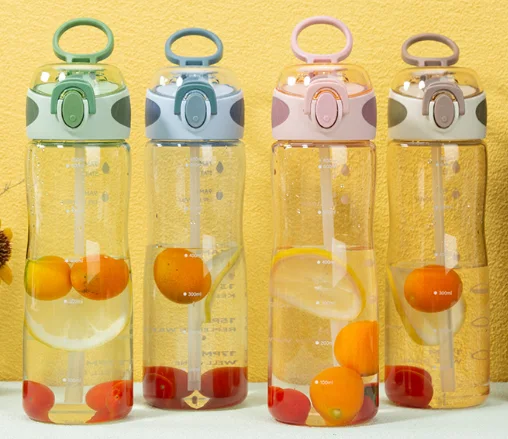 How Can Distributors Build a Profitable Wholesale Water Bottle Assortment?
B2B buyer's guide to choosing a bottle distributor range: buyer segments, verified models, SKU complexity, cartons, demand signals, sampling and service parts.
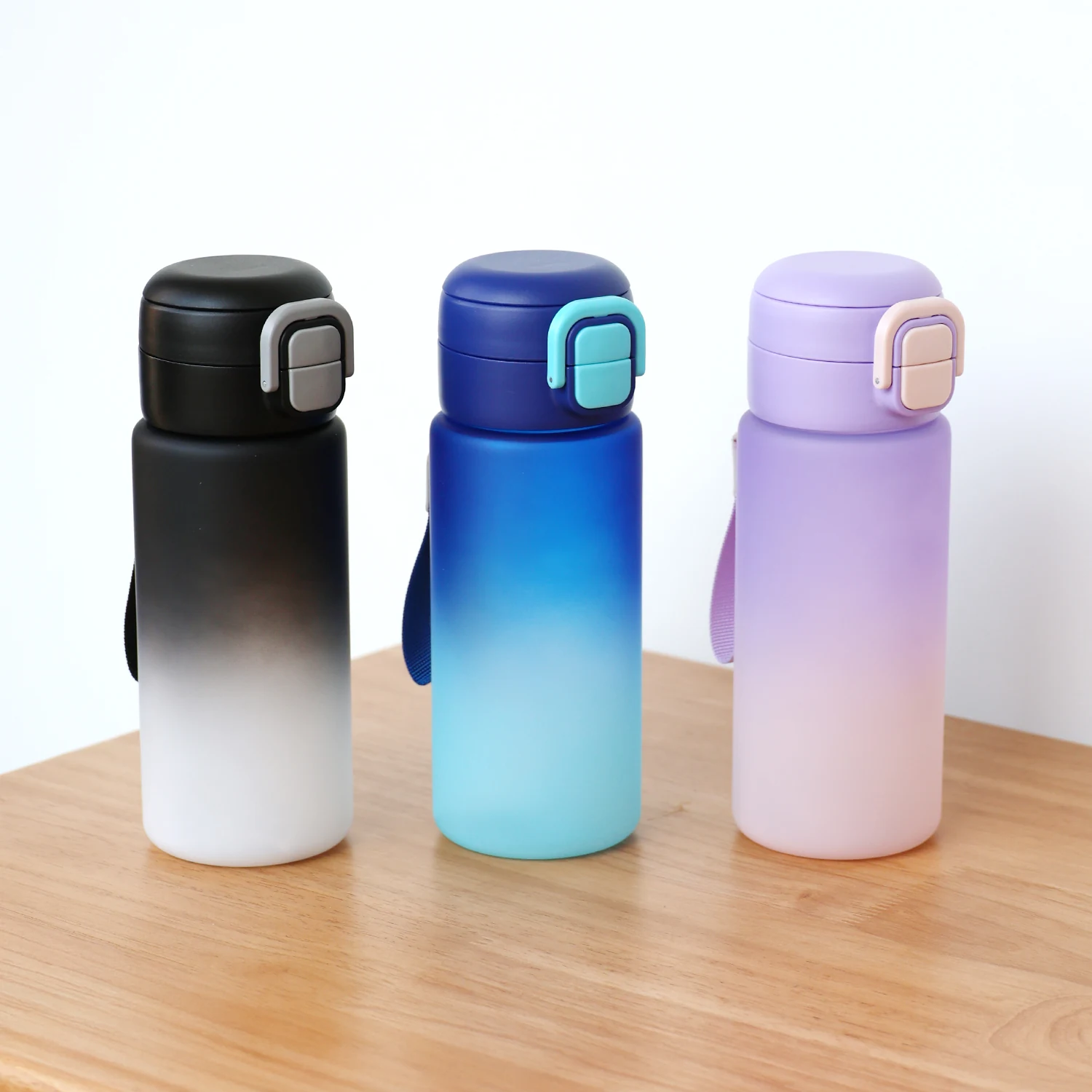 Can You Mix Water Bottle Colors, Sizes and Logos in One Wholesale Order?
How B2B importers plan mixed-SKU plastic water bottle orders: MOQ per model/color, separate logo setups, carton labels, packing lists and supplier quote questions.
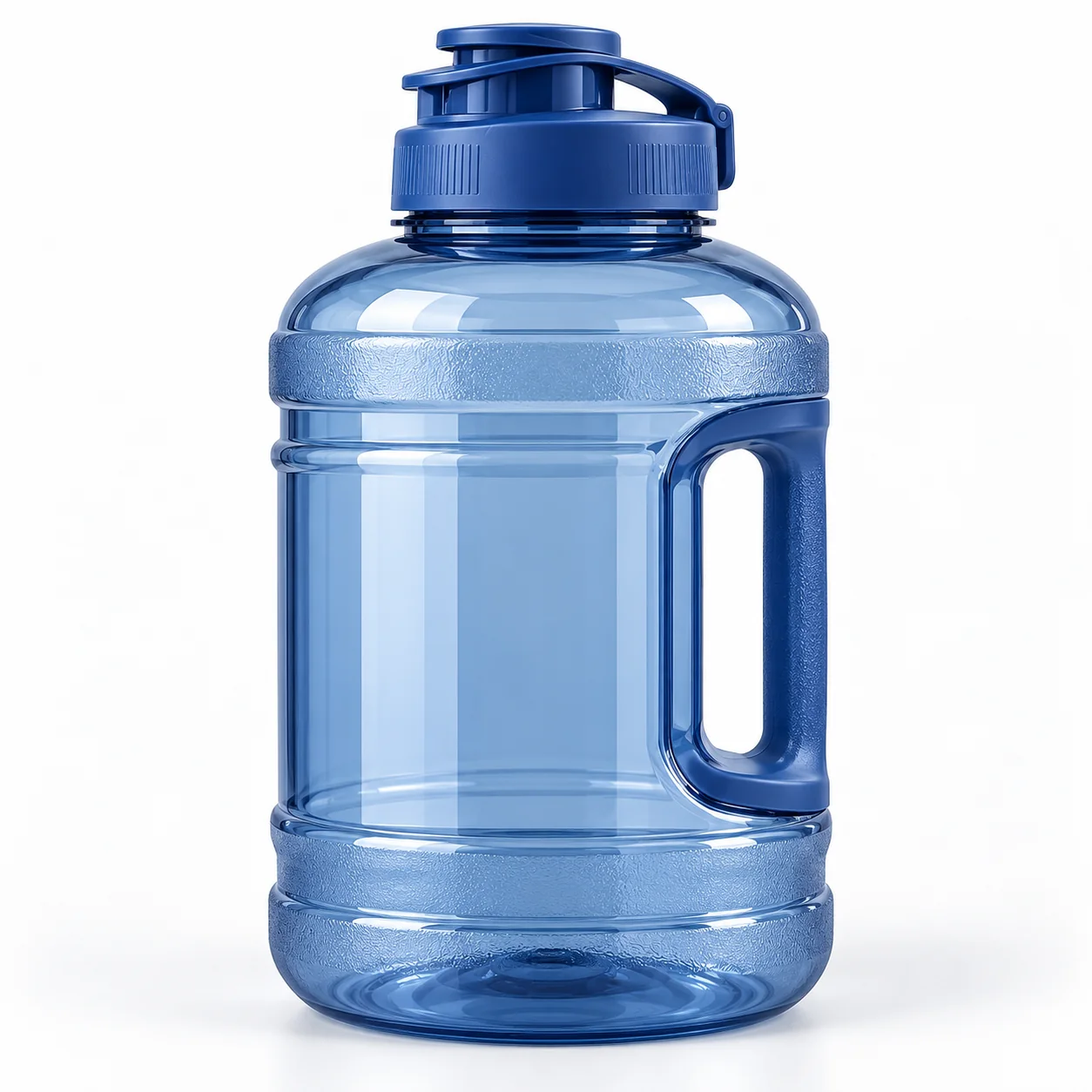 What Should a Wholesale Water Bottle Carton Label Include for a Retailer or 3PL?
A practical B2B carton-label and case-pack checklist for plastic drinkware importers: SKU variants, GTIN versus SSCC, scan tests, pallet records and warehouse receiving.