Replacement parts are not a generic add-on to a wholesale bottle order. A lid that looks similar can have a different thread, seal, mouth opening or fit. This buyer guide shows importers how to identify the approved bottle, calculate a useful spare-parts quantity and protect repeat orders from avoidable compatibility claims.
- Exact bottle model, capacity and neck configuration identified
- Replacement part described by fit and function, not only by color
- Thread, gasket, opening, vent, straw and carry feature checked
Start with the exact bottle model, not a generic lid name
Write the approved bottle model, capacity, body material, neck finish and current lid configuration before asking for spare parts. A screw lid, flip lid, straw lid or carry-ring lid may share a similar outline but use a different thread or seal. Link the request to the exact product record and sample photos, then mark whether the part is for a live order, an after-sales kit or a future replacement program. If the factory offers an alternative, record it as an alternative rather than silently replacing the approved part. This simple identity step prevents a common purchasing mistake: ordering a lid by color or shape while the actual fit is controlled by the bottle neck and closure geometry. Use model 2106 as the product record for the replacement-part request, then confirm the live neck, capacity and closure configuration before ordering.
Check thread, neck, gasket and opening as one compatibility set
A replacement lid should be reviewed as a system of parts. Confirm thread or locking method, neck diameter, gasket position, drinking opening, vent, straw or valve, carry handle and any removable insert. Ask which parts are included and which are sold separately. A lid can close on a bottle and still leak because the gasket is too thin, the vent is misaligned or the thread stops before the seal is compressed. Put the compatibility questions in the RFQ and compare the spare part with the approved bottle sample, not only with a supplier catalogue image. Ask the supplier to confirm the fit on the exact bottle and to state which component controls the seal; record open questions instead of treating a catalogue match as evidence. Compare model 2290 with the approved sample by neck, thread, gasket and opening; a similar silhouette is not proof of a compatible lid.
Separate service kits from a new closure option
A buyer may need a small service kit for customers, a replacement component for a damaged shipment or a new closure for a future product version. These are different purchasing decisions. A service kit should preserve the approved model identity and solve a documented failure mode. A new closure may change the drinking experience, carton height, cleaning instructions, decoration area or leak-test method. Ask the factory to label the request as replacement, repair or product revision, and do not let a low spare-part price hide a change to the finished bottle specification. The order description should make clear whether the part preserves the current SKU or creates a revised SKU, because service stock and new-product development have different controls.
Calculate spare quantity from evidence instead of a blanket percentage
Set a spare-parts quantity by looking at the order size, historic damage, customer service cases, expected handling, cleaning loss and the cost of a second shipment. A distributor serving many retailers may need a small set of lids by model and color, while a single corporate program may need only a controlled replacement pack. Track the part by model, cap color, seal type and packaging, and keep service stock separate from sellable finished goods. If the factory MOQ is larger than the immediate need, ask whether the balance can be packed and labelled for later use rather than mixing untracked parts into a carton. Review the quantity after the next shipment and compare the assumption with actual service demand; a documented adjustment is more useful than an inherited percentage.
Specify individual packing, labels and warehouse control
Small parts are easy to lose and difficult to identify after a mixed shipment. Ask for individual bags or protected packs, model and variant labels, quantity per inner carton, master-carton count, carton dimensions and a packing list that separates spare parts from finished bottles. The label should show the compatible model, part description, color or seal version and quantity. If a spare lid resembles another model, use a barcode or internal reference rather than relying on a photograph. Good packing turns after-sales inventory into a controlled stock item instead of an untraceable box of similar plastic parts. The packing list should allow a warehouse operator to pick one correct part quickly, even when several models use similar colors or shapes. Before adding model 2400 to a service carton, request the compatible model, part description, units per pack and carton mark in writing.
Approve compatibility and leak performance before releasing the parts
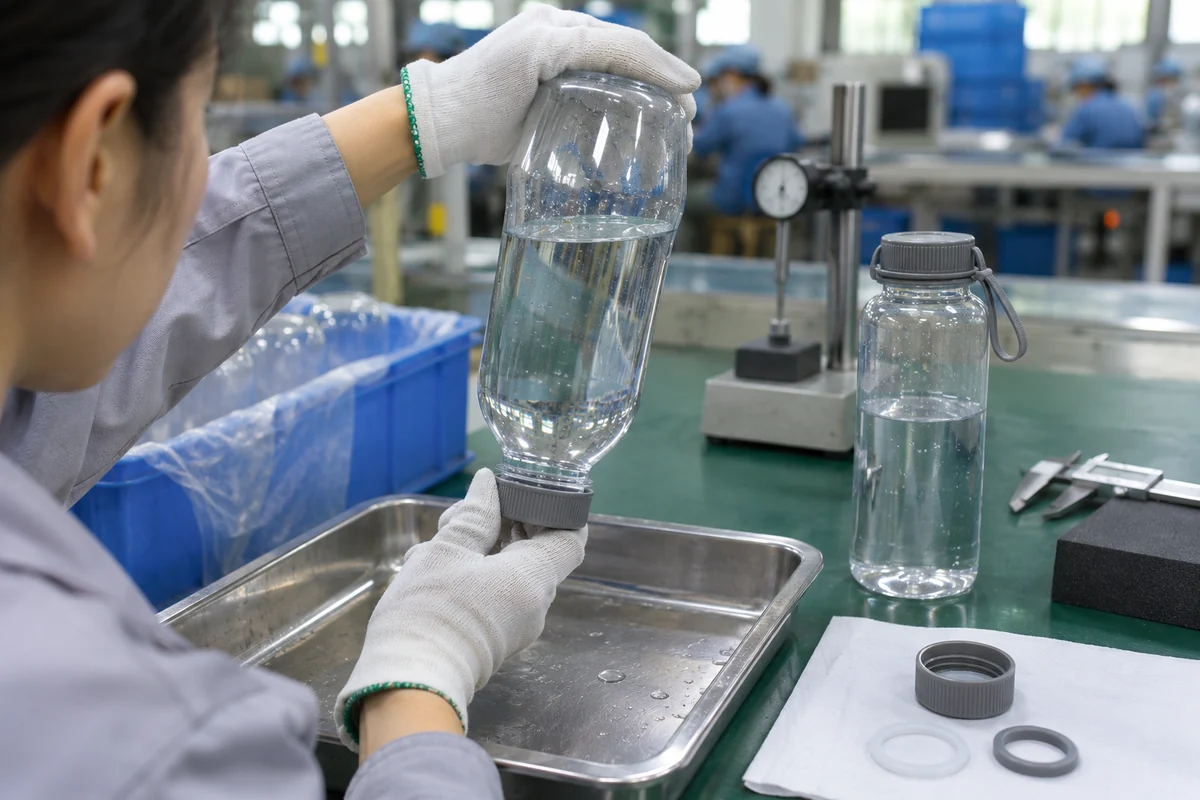
Use an approved bottle and the proposed replacement part for the practical check. Close the lid by normal hand force, inspect the gasket and thread, fill to the defined level, turn the bottle over and record the test condition and result. If the bottle is used in a bag, include the movement or handling that matters to the buyer. Do not convert one simple inversion check into a lifetime performance claim. Record the model, capacity, lid version, seal, date, sample identity, test condition and open questions. Any change to resin, gasket, thread or decoration should trigger a new review. The result belongs to the tested model and part combination only; any resin, seal, thread or decoration change must be treated as a new review point.
Keep a repeat-order record for service and supplier accountability
After delivery, record the ordered quantity, received quantity, model and variant, missing or damaged parts, fit issues, leak complaints, customer replacements and the supplier response. Compare the part to the approved record before the next reorder. If a supplier changes a gasket, mold, color or packing format, preserve the old approval and create a new revision rather than overwriting the history. This gives the importer evidence for a service decision and lets the next buyer repeat a successful order without guessing which lid or seal was used. This history also gives the supplier a precise corrective-action brief and prevents the same compatibility issue from being repeated in the next wholesale order.
Reference points
A replacement part is a controlled product configuration: the model, fit, seal, packaging and approval evidence must stay connected.
Practical next step: Send the supplier a model-level spare-parts table and ask them to confirm compatibility and packing line by line.
Primary references
Compatibility examples are procurement controls, not a guarantee of leak performance for an unspecified bottle or lid.
Replacement-part decision matrix
Use this table to turn an after-sales request into a controlled part specification.
| Decision | What to confirm | Why it matters |
|---|---|---|
| Identity | Model, capacity, neck and closure version | Prevents a visually similar but incompatible lid |
| Fit | Thread, gasket, opening, valve and handle | Connects the part to the actual bottle |
| Quantity | Damage, service and handling evidence | Avoids both stock-outs and untracked excess |
| Packing | Part label, units per pack and carton mark | Keeps small parts identifiable in the warehouse |
| Approval | Actual bottle, test condition and result | Makes compatibility evidence repeatable |
| History | Received parts, complaints and changes | Improves the next service order |
Buyer decision criteria, not XUYI certification, published MOQ or guaranteed delivery times. Verify the exact model and market requirements.
Buyer checklist
- Exact bottle model, capacity and neck configuration identified
- Replacement part described by fit and function, not only by color
- Thread, gasket, opening, vent, straw and carry feature checked
- Service kit separated from a new closure or product revision
- Quantity based on damage, service and handling evidence
- Model, cap color, seal version and packing recorded
- Individual pack, label, inner carton and master carton specified
- Approved bottle and replacement part tested together
- Test condition, sample identity and result saved
- Repeat-order and supplier change history retained
Frequently asked questions
Can I order a replacement lid by matching a product photo?
A photo is only a starting reference. Confirm the exact model, neck, thread or locking method, gasket, opening and included parts against an approved bottle sample before ordering.
Should spare lids use the same color as the original bottle?
Usually the spare should match the approved variant, but color alone does not prove compatibility. Record body color, lid color, model, seal and packing as separate fields.
How many replacement parts should a distributor keep?
Use order volume, historic damage, service cases, handling conditions and the cost of a second shipment. Keep a model-level record rather than applying one percentage to every bottle.
When does a new lid require a new sample approval?
When the thread, gasket, resin, opening, valve, decoration, cleaning instruction or packing changes, treat it as a new configuration and review it on the actual bottle.
Need a quote for a specific model?
Send the model, expected order quantity, logo requirements and destination market. XUYI can review confirmed material and customization options.
Request a Plastic Bottle Quote →