“Leakproof” is not a useful approval standard unless the buyer defines the complete bottle set and the test condition. This guide explains a practical way to check the body, cap, seal and packing before a wholesale water bottle order moves into production. The practical output is a repeatable approval record that names the tested assembly and the condition, rather than an unsupported promise that every bottle is leakproof.
- Exact body, cap, seal and accessory set identified
- Capacity recorded in ml and approximate US fl oz class
- Body, lid and seal materials confirmed by SKU
Test the complete bottle set, not an isolated cap
A leak check should use the exact bottle body, cap, seal, straw or carry component and decoration that the customer will receive. A cap can fit one body and leak on another if the neck finish, thread, gasket seat or molded tolerance changes. Start the approval record with the model number, capacity in ml and approximate US fl oz class, body material, cap material, seal type and color. Ask the supplier to identify any removable parts and the way they are assembled before testing. A buyer should also check whether the sample is a stock version while the bulk order will use a custom color or a different lid. The purpose of the first test is not to use the word “leakproof” as a marketing promise; it is to prove that the selected components work together under a defined condition. Keep photos of the assembled sample and write down which parts were tested so a later replacement cap is not treated as automatically equivalent. Define the tested assembly before defining the word leakproof. Record the exact body, cap, gasket, straw or valve, accessory, capacity, material and SKU. A cap tested on a different body or a sample with a different seal is not evidence for the production combination. Another reviewer should be able to rebuild the same set without guessing. Review model 2062 as a sourcing reference before approving this variant.
Inspect the seal, thread and closure before adding water
Many leak problems can be found before a filled test if the buyer looks at the contact surfaces carefully. Inspect the neck finish, cap thread, gasket position, valve or straw connection and any visible flash or deformation. Close the cap using the normal hand force that a customer or warehouse worker would use, then check whether the cap bottoms out evenly and whether the seal is compressed consistently. Do not tighten a plastic cap with an improvised tool unless the product instruction specifically requires it; excessive force can distort a seal or create a result that normal use cannot repeat. If the bottle has a flip top, carry loop or drinking spout, check that each moving part reaches its intended position. Record the assembly condition, not only the final pass or fail. A clear pre-test inspection helps the factory locate whether a leak is caused by a damaged gasket, a mismatched thread, a cap component or a handling step. Start with a visual and mechanical pre-check. Close the cap normally, inspect the thread or neck finish, check the gasket seat, look for distortion and operate any valve or straw part. This does not prove final performance, but it catches assembly problems before water is added. The closure type matters because the failure points are different.
Use a repeatable filled-and-inverted test
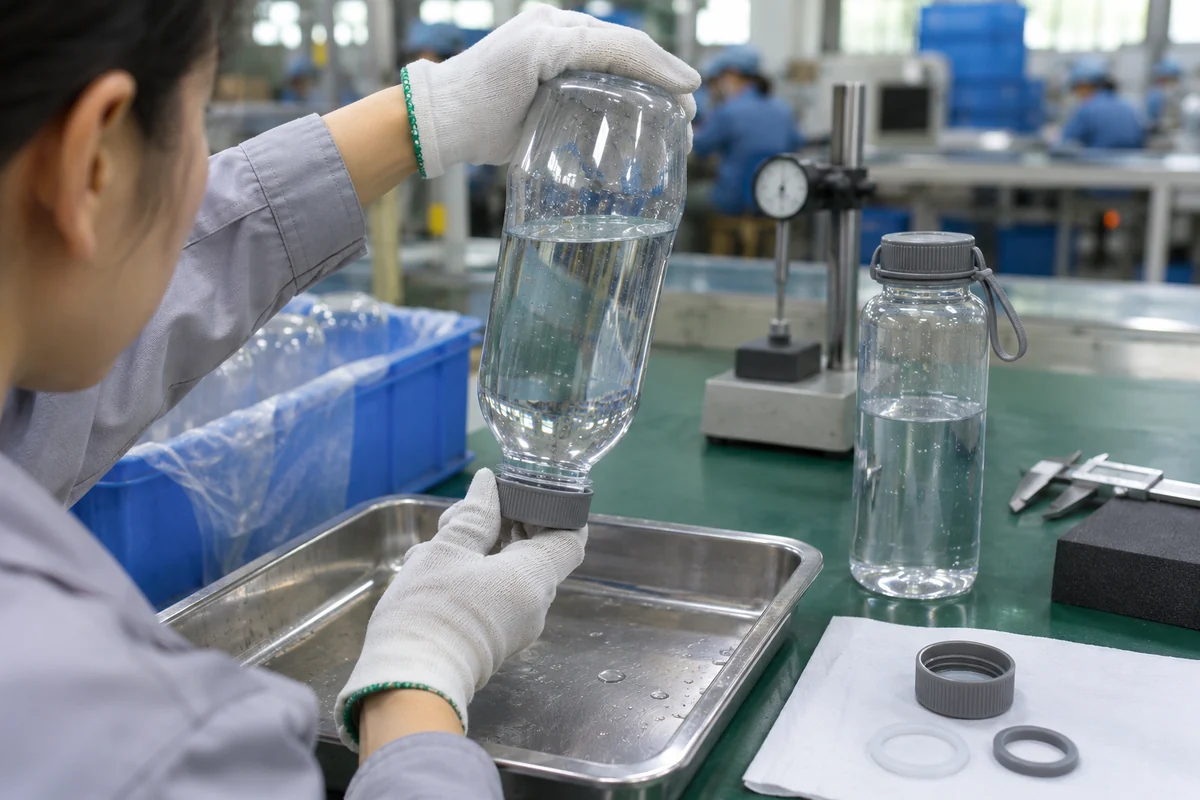
The basic test should be easy for two teams to repeat. Fill the bottle to a defined level with water at a defined temperature, close it with the approved cap and wipe the outside dry. Hold or place it in the same orientation for a stated time, then invert it over a clean tray and inspect the neck, cap, seal and drinking opening. Define what counts as a failure: a visible drop, a continuous wet trail, a measured volume loss or water entering a protected compartment. Record the start time, test duration, fill level, cap condition and result. If the bottle is intended for a bag or parcel, add a short movement simulation after the static inversion. A buyer should avoid treating one sample and one quick shake as a universal certification. The useful outcome is a written condition that the factory can reproduce during sample approval and production QC, with the exact model and component combination attached. A repeatable static check needs a written condition: fill level, liquid, temperature, closure method, orientation, hold time and failure definition. Photos should show model identity and result, not only a wet table. Do not turn an informal inversion check into an unsupported certification; state exactly what was checked and under which condition. Review model 2063 as a sourcing reference before approving this variant.
Add transport movement and position changes
A bottle may pass a stationary inversion but leak after repeated movement in a delivery carton or sports bag. After the first static check, place the approved bottle in the intended individual pack and simulate the likely route: upright storage, horizontal transport, cap-down position and moderate handling. Check whether the cap rubs against the carton, whether a carry loop pulls the closure sideways and whether a divider presses on the lid. If the bottle has a straw or valve, inspect the moving component after the simulation rather than assuming the first pass remains valid. The buyer should record the packing version, orientation and handling duration, because a change to the carton or insert can change the force applied to the closure. For a distributor order, this test is especially useful when the same model will be sold into outdoor, fitness or travel channels with different carrying habits. The test does not replace a formal carrier protocol; it creates practical evidence for the selected order route. Transport can change the result even when a bottle passes a static check. Review orientation, carton pressure, movement, vibration or repeated handling and connect the packing method to the sample. If a straw, valve or gasket can be pressed by the carton, inspect that point after the simulation. Record the sample and packing version.
Check cleaning, temperature and repeated opening conditions
Leak performance is connected to how the bottle is cleaned and used. Ask whether the intended market will hand-wash the bottle, use a dishwasher program, fill it repeatedly or carry flavored drinks. If a seal is removable, check that it can be reinstalled correctly and that the cleaning process does not twist or damage it. If the buyer expects warm liquid, ask the supplier to respond to that exact condition instead of extending a cold-water sample result to a different use. Repeat the open-and-close cycle enough times to reveal whether the gasket shifts or the cap thread becomes difficult to engage. Record the water condition, temperature assumption, cleaning step and number of cycles in the approval record. This protects both sides from a vague “leakproof” claim that ignores actual use. A factory can discuss suitable materials and components, but the final statement should remain tied to the tested model, tested condition and approved sample. Use conditions stay inside the evidence boundary. Cleaning, temperature, beverage type, seal removal and repeated opening can change component behavior. Agree which conditions matter for the channel and record them as separate checks. Never turn a result at one temperature, fill level or opening cycle into a blanket claim for every use.
Connect sample approval to production QC
The approved sample becomes useful when the factory can translate it into a production check. Ask which dimensions, seal positions, cap components, torque or visual points are checked during production, and how many units are sampled. Confirm what happens when a unit fails and how the affected batch is isolated or reworked. The buyer should keep the approved sample photos, model identity, capacity, materials, color, cap, seal and packing method with the order record. If a factory changes a resin, gasket, cap mold or decoration surface, request a new review instead of assuming the old result still applies. A simple QC table can include assembly condition, fill level, inversion time, movement simulation, visual leakage and result disposition. This gives procurement, quality and the supplier the same language and makes a repeat order auditable without requiring one person to remember the original test. The sample becomes valuable when it connects to production control. Ask which dimensions, components, seal positions, closure checks or visual points are monitored, what sampling plan is used, and what happens to a failed unit or batch. If resin, gasket, cap mold, decoration or assembly changes, reopen approval. Review model 2065 as a sourcing reference before approving this variant.
Keep a leak-test record for repeat orders and complaints
A leak record should be easy to find when a customer complaint or repeat order appears months later. Save the model number, capacity in ml and approximate oz class, body and lid material, seal version, color, artwork, sample date, test condition, duration, packing method, photos and result. If a complaint occurs, compare the returned bottle with the approved identity before deciding that the entire model failed. A changed cap, replacement seal, different filling level or new packing method can create a different result. For repeat orders, ask the factory to confirm that the approved component set and QC condition remain unchanged, or request a new sample when a change is introduced. This discipline produces better evidence for buyers and better feedback for production than a simple note saying “passed leak test.” It also helps the sales team answer a technical question accurately without promising a performance that was never tested for the customer’s use case. Keep the test record with the reorder identity and complaint process. Save model, ml and approximate oz class, materials, cap and seal version, color, artwork, date, condition, duration, packing, photos and disposition. Compare a returned bottle with the approved identity before deciding the whole model failed.
Wholesale bottle leak-test decision matrix
Use this matrix to define a repeatable sample approval condition before production.
| Decision | What to confirm | Why it matters |
|---|---|---|
| Components | Body, cap, gasket, straw and accessory set | A complete set is needed for a meaningful result |
| Pre-check | Thread, seal, valve and closure condition | Finds visible assembly issues before filling |
| Static test | Fill level, duration, orientation and failure rule | Makes two teams able to repeat the test |
| Movement | Packing, position and handling simulation | Connects closure performance to the route |
| Use | Cleaning, temperature and open-close cycles | Avoids extending a result beyond its condition |
| QC | Sampling, failed-unit handling and record | Makes production and reorders auditable |
Buyer decision criteria, not XUYI certification, published MOQ or guaranteed delivery times. Verify the exact model and market requirements.
Buyer checklist
- Exact body, cap, seal and accessory set identified
- Capacity recorded in ml and approximate US fl oz class
- Body, lid and seal materials confirmed by SKU
- Neck finish, thread, gasket and moving parts inspected
- Fill level, water condition and test temperature defined
- Inversion time and pass/fail condition recorded
- Transport orientation and movement simulation reviewed
- Cleaning, repeated opening and intended-use conditions considered
- Production QC sampling and failed-unit handling confirmed
- Photos and test record linked to the reorder identity
Frequently asked questions
How should a buyer test a wholesale water bottle for leaks?
Use the complete approved body, cap and seal. Define the fill level, water condition, closure method, inversion time and failure condition, then record the result with photos.
Is turning a bottle upside down enough to approve it?
It is a useful basic check but not a complete approval for every route. Add movement, packing, cleaning or repeated-opening conditions that match the intended use.
Why can a sample pass while a production bottle leaks?
The cap, gasket, thread, material, color or assembly condition may have changed. Connect the sample to production dimensions, components and QC sampling.
What should be saved after a leak test?
Save the model, ml and approximate oz class, materials, cap, seal, color, test condition, duration, packing method, photos and result disposition.
Need a quote for a specific model?
Send the model, expected order quantity, logo requirements and destination market. XUYI can review confirmed material and customization options.
Request a Plastic Bottle Quote →