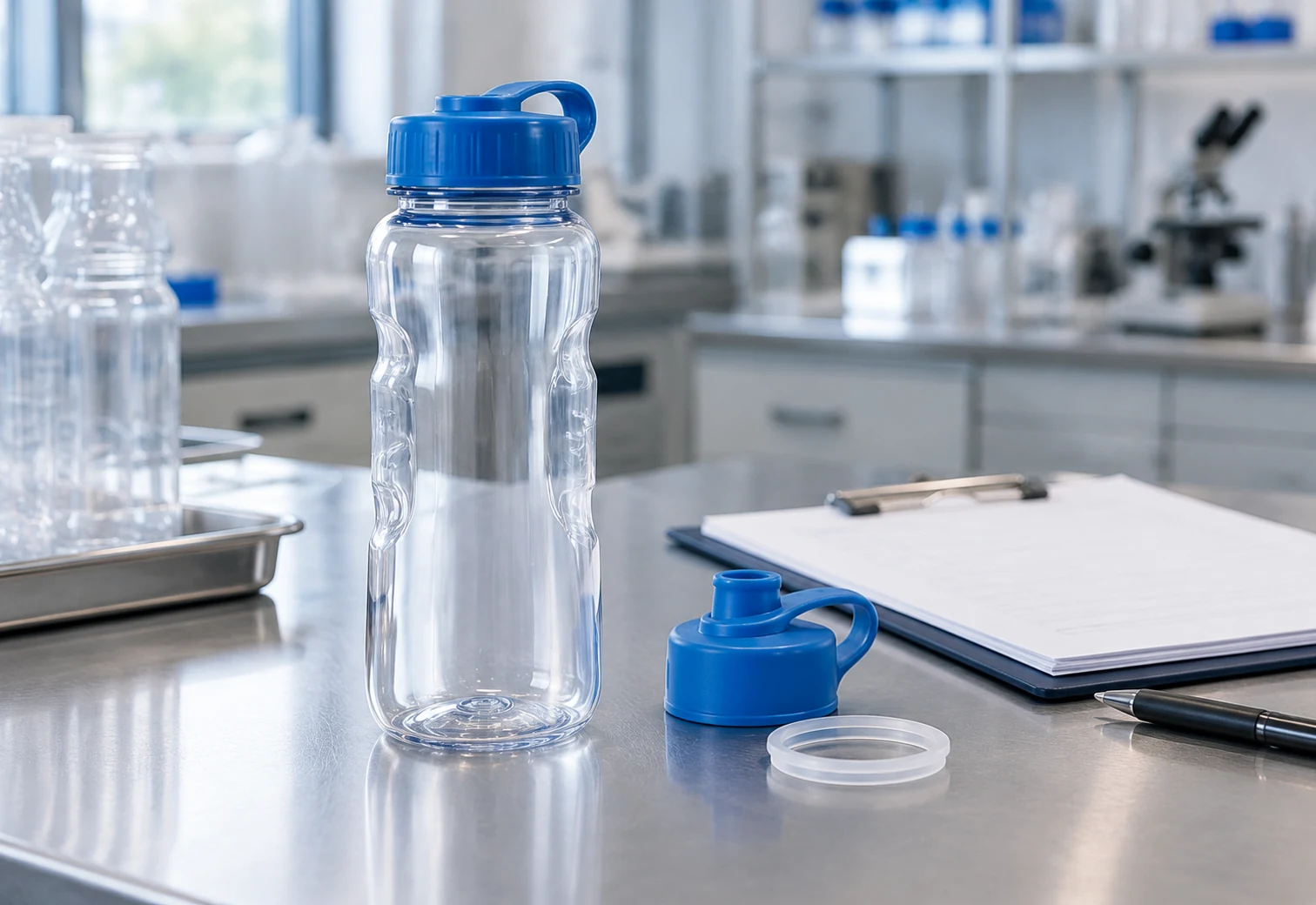
A supplier saying a bottle is food safe is a starting point, not a complete purchasing record. Importers need evidence that matches the actual bottle, its components, intended use and destination market. A clear body, colored cap, straw and seal may use different materials, and a report for one resin or sample does not automatically cover every finished configuration. This guide turns a broad compliance request into a practical document checklist. It is procurement guidance, not a certification of any XUYI product; the buyer should confirm applicable legal requirements for the exact market and use.
- Name the destination market and intended drink-use conditions
- List body, cap, straw, seal, valve and other contact components
- Identify material grades, suppliers and colorants where relevant
Start with the destination market and intended use
Before asking for a certificate, define where the bottle will be sold and how it will be used. Specify whether it is intended for cold or room-temperature drinks, repeated use, a straw or spout, and any cleaning or temperature conditions that matter. The United States and European Union do not use one interchangeable approval label for every plastic bottle. Requirements depend on the applicable rules, the substances in the material, the finished article and the conditions of contact. A supplier can only respond precisely when the market and use case are clear.
Map every component that can contact a drink
Request a component list for the bottle body, cap, straw, gasket, valve and any other part that may touch the liquid during normal use. Ask separately about colorants, additives, coatings or printing where relevant, including whether decoration is on an exterior or contact surface. A declaration for the body resin alone may not cover a cap, seal or colored component sourced from another supplier. Use an annotated product drawing or approved sample to identify each part, then ask the factory to link the material specification and supporting evidence to that exact component. Use sports bottle model 2095 as a model-specific reference when listing the body and closure parts; its product page is not a substitute for compliance evidence.
Ask for a declaration tied to the exact product
The most useful supplier statement identifies the product or model, material grade or component, intended food-contact conditions, supplier and document revision. Ask what regulations or authorizations support the claim, what limitations apply, and whether the statement covers the finished bottle or only a raw material. In the United States, FDA food-contact compliance is not a universal badge issued to every finished bottle; the regulatory status of substances and their authorized uses matters. Request a signed, product-specific letter or declaration and retain it with the quotation, sample approval and purchase order.
Read test reports for scope, not just the logo
Check the report issuer, date, sample description, model or revision, test method, conditions, results and conclusion. The tested sample should match the body, cap, straw, gasket, color and intended use of the order closely enough to support the claim being made. Ask whether migration testing, repeated-use conditions, temperature, contact time or other parameters are relevant to the destination market. A report for a different bottle shape or a clear resin does not automatically prove a colored version is covered. If the scope is unclear, ask the laboratory or supplier to explain it before accepting the report. For sports bottle model 2310, confirm the exact model revision and component scope before matching any supplier report to an order; do not infer certification from appearance.
Separate United States and European Union requests
For a US-bound order, ask the supplier to identify the applicable FDA food-contact basis for each relevant substance and intended condition of use, with supporting declarations or documentation. For plastic food-contact articles placed on the EU market, Regulation (EU) No 10/2011 is a key specific measure and includes requirements for supporting documentation and a declaration of compliance where applicable. The exact document set depends on the product and regulatory scope, so do not treat a generic FDA statement as an EU declaration or the reverse. Confirm current rules with your compliance specialist or qualified adviser.
Connect documents to batches and change control
Evidence is only useful when it can be connected to the product actually shipped. Record the model, resin supplier and grade where available, component revision, color or masterbatch, report number and approved sample ID. Ask how the supplier notifies buyers if a resin, cap, gasket, pigment, manufacturing site or design changes. A change can affect the relevance of earlier evidence even when the bottle looks similar. For repeat orders, keep a controlled document pack and require written review before an unapproved material substitution. This also makes it easier to investigate a complaint without guessing which version was delivered. Record sports bottle model 2400 by model and revision in the buyer file so a later reorder can be checked against the same approved product configuration.
Put the evidence requirements into the purchase order
Write the required documents and acceptance steps into the RFQ or purchase order rather than leaving them in a chat message. Identify the market, exact model and components, intended use, required declaration or test report, sample revision and delivery of final documents. State who reviews discrepancies and whether production may proceed while a document is missing. Avoid vague promises such as FDA approved, food grade or fully certified unless the supplier explains the exact legal basis and scope. A clear requirement lets the buyer compare factories on evidence quality, not on the confidence of a sales claim.
Official references for food-contact documentation
US food-contact status depends on relevant substances and authorized conditions of use; EU plastic food-contact rules have their own documentation requirements. Neither a resin name nor a generic marketing badge establishes that every finished configuration is covered.
Practical next step: Request evidence tied to the exact bottle, components, intended use and destination market.
Primary references
- FDA: Determining the regulatory status of food-contact material components ↗
- EUR-Lex: Commission Regulation (EU) No 10/2011, current consolidated text ↗
External regulations and standards are independent references, not product certification or proof of testing by XUYI. Confirm applicability and the latest rules for the exact product, destination and transaction date.
Food-contact document review: what each record should prove
Use this matrix to check whether the supplier evidence is specific enough for the intended bottle, market and use conditions.
| Record | What to verify | Common gap |
|---|---|---|
| Component declaration | Model, part, material grade, intended use and revision | Only a generic resin name |
| Test report | Sample identity, method, conditions, result and date | Report belongs to another bottle |
| US compliance basis | Applicable authorization for relevant substances and uses | Claim says FDA approved without scope |
| EU documentation | Applicable Regulation (EU) No 10/2011 declaration and support | US statement offered as EU evidence |
| Traceability | Component supplier, lot or revision and approved sample | No link to the shipped configuration |
| Change control | Written notice and re-review before substitutions | Old documents reused after a material change |
Buyer decision criteria, not XUYI certification, published MOQ or guaranteed delivery times. Verify the exact model and market requirements.
Buyer checklist
- Name the destination market and intended drink-use conditions
- List body, cap, straw, seal, valve and other contact components
- Identify material grades, suppliers and colorants where relevant
- Request a product-specific declaration with revision and scope
- Review test report sample identity, method, conditions and results
- Confirm the applicable US or EU regulatory route separately
- Match documents to the exact model and approved sample
- Record lot and component traceability for repeat orders
- Require written notice before material or component substitutions
- Keep the compliance pack with the RFQ, PO and sample approval
Frequently asked questions
Does an FDA logo or statement prove the finished bottle is approved?
No. US food-contact compliance depends on the applicable authorization and intended conditions of use for relevant substances. Ask what the statement actually covers and request product-specific supporting documentation.
Can one test report cover every color and lid option?
Not automatically. The report scope, tested sample, components, colorants and conditions determine how far the evidence can be applied. Ask the supplier or laboratory to confirm coverage for the exact configuration.
What should an EU buyer ask for?
Ask whether Regulation (EU) No 10/2011 and other applicable food-contact rules cover the finished article, and request the relevant declaration of compliance and supporting documentation where required. Confirm the current requirements for your exact use.
Should I accept a generic food-grade certificate?
Only after checking its issuer, scope, date, product identity and legal relevance. A generic certificate may not identify the bottle, components, test conditions or destination-market requirements you need.
Need a quote for a specific model?
Send the model, expected order quantity, logo requirements and destination market. XUYI can review confirmed material and customization options.
Request a Plastic Bottle Quote →