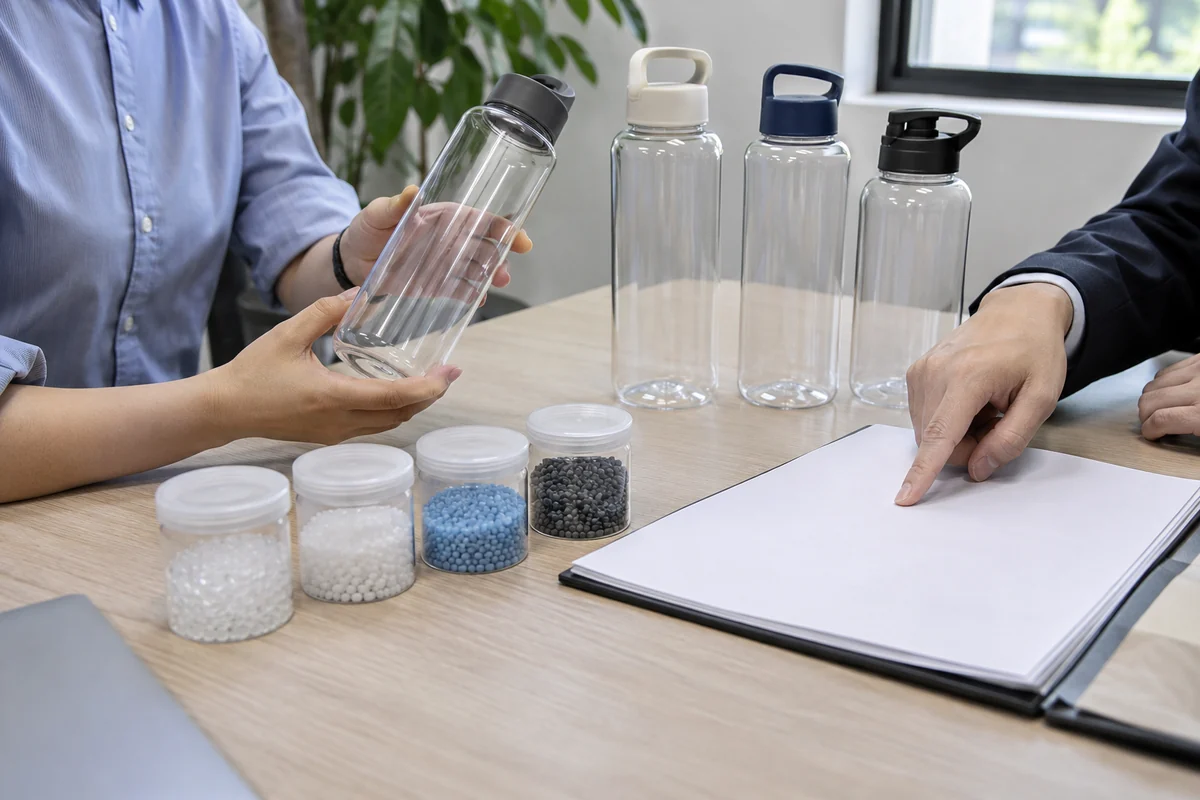
Recycled plastic is not a complete compliance answer. A wholesale buyer needs the polymer, feedstock, process, intended use and market evidence before using a food-contact or sustainability claim.
- State the exact polymer for the body, cap, seal and any liquid-contact layer.
- Separate recycled content, recyclable design, post-consumer feedstock and regrind.
- Record beverage, temperature, contact time, reuse pattern and destination market.
Do not start with the green claim
Begin by separating the commercial phrase from the technical question. Recycled content, post-consumer recycled, reprocessed and recyclable can describe different things, and none of them by itself proves that a bottle is suitable for direct food contact. Write the intended use, beverage or food type, temperature, contact duration, repeated-use expectation and destination market in the buyer brief. Then ask which component the claim covers: bottle body, cap, seal, straw, sleeve or packaging. A clear bottle made from one resin with a cap made from another is a multi-component product. Do not let a sustainability phrase replace a material identity, a source-control explanation or the documents required for the market where the finished product will be sold.
Identify polymer and recycled feedstock
Ask the supplier to state the exact polymer family for each food-contact component and whether the input is virgin resin, post-industrial regrind, post-consumer recycled material or a controlled closed-loop stream. Record the source, collection method and whether recycled material is used in the bottle body, a non-contact layer or a separate accessory. Do not infer a polymer from transparency, color or the sound of the bottle. Ask whether colorant, additive, adhesive, printing ink and gasket are included in the same declaration. If the supplier can only say eco plastic, keep the item in a material-clarification state and do not publish a food-contact or recycled-content claim until the exact construction is documented. Use 500ml / 16.9 oz class sports bottle model 2095 only after its component scope and document package are confirmed.
Request process and source-control evidence
For recycled plastic intended for food contact, the recycling process and input controls matter as much as the name of the polymer. Ask how feedstock is collected, sorted, protected from contamination and processed, and who owns the process documentation. Request the relevant declaration, process description, test reports or regulatory opinion that the supplier can share for the exact material and use. Do not treat a generic resin certificate, a factory logo or a laboratory-looking page as proof of a finished bottle. FDA guidance discusses process information, contamination control and proposed conditions of use; European rules also address recycled food-contact plastic and quality control. Connect the evidence to the actual bottle component and destination market.
Separate food contact from general product safety
A bottle can have a material claim relevant to food contact and still require separate checks for closure, gasket, ink, adhesive, odor, migration, temperature and repeated-use conditions. Ask whether supplied evidence covers the complete assembled product or only the resin. Check cap and seal separately when the liquid contacts them, and confirm that a sleeve or decoration does not change the intended contact surface. Do not promise that a recycled bottle is safe for every drink, temperature or cleaning method. Describe the reviewed scope and tell the buyer what remains to be confirmed. This answers a real procurement question instead of turning a partial document into a broad marketing guarantee. Use 650ml / 22 oz class PP/PC sports bottle model 2100 only after its component scope and document package are confirmed.
Match evidence to the destination market
The same material may face different documentation and labeling expectations in the United States, the European Union or another destination. Record the market, importer of record, intended food contact, temperature and use duration before asking for a compliance package. For the EU, recycled plastic food-contact rules include requirements around recycling processes and quality control; for the US, FDA evaluates recycled plastic processes and proposed conditions of use. These references are not a certificate for a specific XUYI model. They are a reason to request the correct supplier evidence and, where necessary, obtain specialist regulatory review. Never solve a market question by copying a claim from another language page or another product family.
Use precise language on the product page
Commercial copy should distinguish made with recycled content, recyclable after use, recycled plastic available for inquiry, and food-contact documentation supplied for the reviewed configuration. Use the narrowest phrase that source evidence supports. If the supplier has not confirmed the percentage, do not publish a percentage. If evidence covers resin but not cap or decoration, say so. If the buyer needs an exact recycled-content or compliance statement, make it a document request in the RFQ and hold the public claim until review is complete. This is more useful for searchers because it answers what they must verify instead of repeating a vague sustainability adjective. Use 1000ml / 32 oz class gradient sports bottle model 2516 only after its component scope and document package are confirmed.
Put the document package into the RFQ
The RFQ should name the exact SKU, body and cap materials, capacity in ml and approximate ounce class, color, recycled-content question, intended beverage, temperature, contact duration, destination market, packaging and artwork. Ask for source-control description, process evidence, applicable declaration, test scope, revision date and change-notification rule. State that a resin, cap, seal or decoration change requires a new review. Keep the approved sample and document set together so a later reorder cannot use an old statement for a new construction. The buyer does not need to promise a certification that has not been issued; the buyer needs a traceable question, a controlled answer and clear limits on public wording.
Recycled-plastic evidence matrix
Separate material identity, process evidence, use conditions and public wording.
| Decision area | Buyer check | Safe record |
|---|---|---|
| Material | Polymer and component scope | Body, cap and seal listed. |
| Feedstock | Origin and contamination control | Supplier evidence retained. |
| Use | Food, temperature and duration | Conditions stated. |
| Market | Destination and importer obligations | Market scope checked. |
| Claim | Percentage, recyclable or contact wording | Only supported wording published. |
Buyer decision criteria, not XUYI certification, published MOQ or guaranteed delivery times. Verify the exact model and market requirements.
Buyer checklist
- State the exact polymer for the body, cap, seal and any liquid-contact layer.
- Separate recycled content, recyclable design, post-consumer feedstock and regrind.
- Record beverage, temperature, contact time, reuse pattern and destination market.
- Ask for source-control and recycling-process evidence for the stated construction.
- Check whether documents cover the assembled bottle rather than resin only.
- Review cap, gasket, ink, adhesive, odor, migration and cleaning conditions.
- Match the evidence to the United States, EU or other destination requirements.
- Do not publish a recycled percentage or food-contact claim without a source.
- Add revision dates and a change-notification rule to the RFQ document set.
- Hold the public claim until the exact SKU and evidence scope are approved.
Frequently asked questions
Can recycled plastic be assumed food-contact safe?
No. Recycled content does not by itself prove suitability for food contact. Verify the exact resin, process, assembly and destination-market documentation before making a claim.
Does recycled content guarantee the same performance as virgin resin?
No. Clarity, color, odor, impact behavior and cleaning performance depend on the specified material and process. Compare production-representative samples and the supplier's evidence for the offered SKU.
What evidence should an importer request?
Request the material specification, applicable food-contact declaration or test records, component scope, production reference and any use or cleaning limits that apply to the complete bottle and closure.
How should a recycled-content claim be written for a product listing?
Use only the percentage, material name and scope that the supplier has documented for the exact product. Do not turn a general recycled-material statement into a certification or safety claim.
Need a quote for a specific model?
Send the model, expected order quantity, logo requirements and destination market. XUYI can review confirmed material and customization options.
Request a Plastic Bottle Quote →