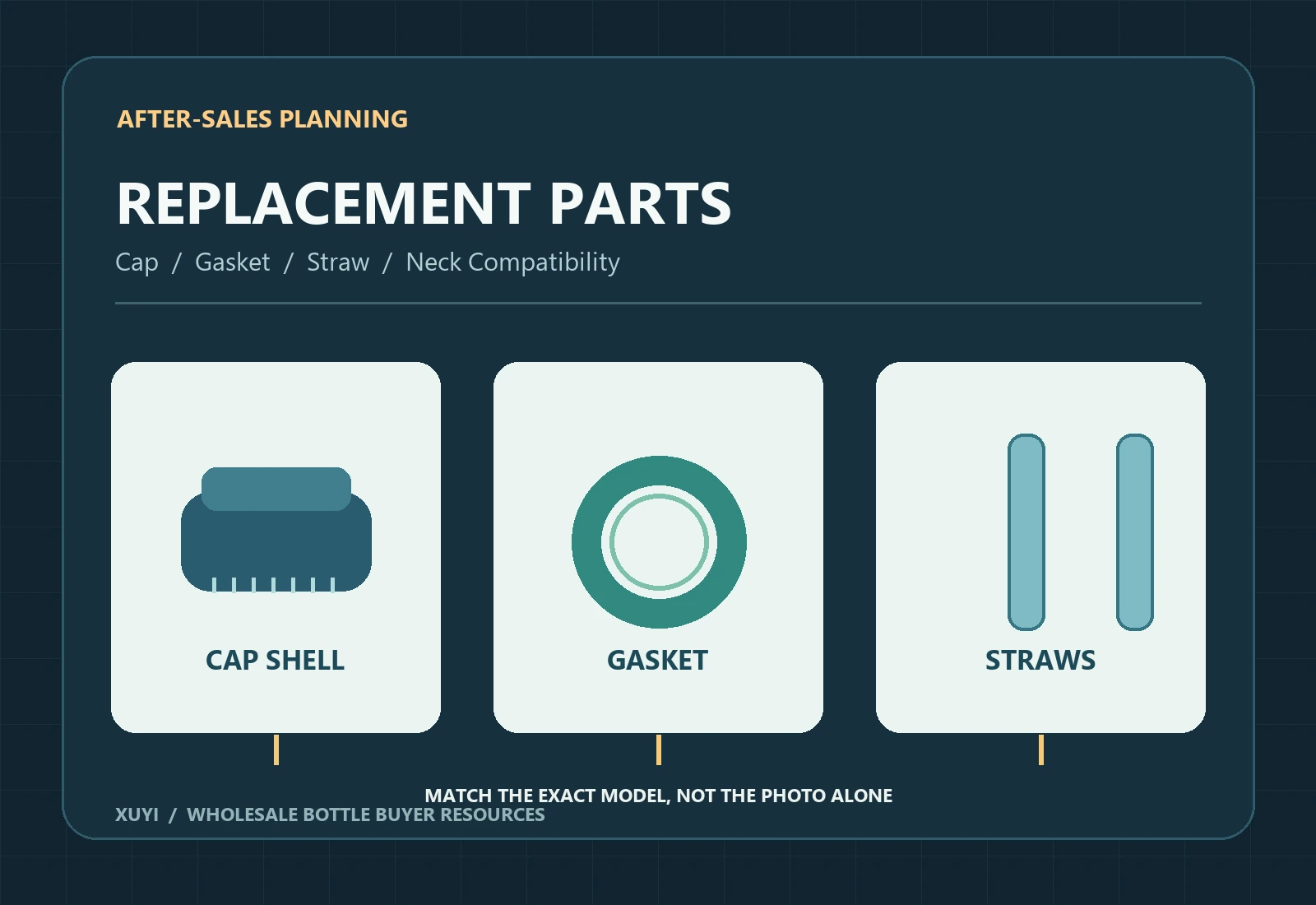
The first order sells bottles. The second year reveals whether buyers can obtain a matching cap, straw or seal after a part gets lost. Most complaints about replacement parts start with a simple purchasing error: the bottle body was specified, but the lid revision and spare-parts availability were not. A spare-parts plan is not glamorous, yet it can reduce support work and protect a repeat-order program.
- Record exact neck finish and approved lid part number
- Confirm gasket, straw, valve and hinge part codes
- Request the supplier's SKU-to-spare compatibility matrix
A replacement cap is not defined by diameter alone
Two lids that seem to fit the same mouth diameter may have different thread starts, sealing-land geometry, gasket compression or drinking-port construction. Even if a replacement screws on, it may not seal or perform as intended. Ask for the exact neck finish or compatible factory model, the lid drawing or part number and a documented compatibility list. Do not advertise a universal spare cap without checking each bottle-and-lid pair. A confirmed fit is a system approval, not a visual guess.
Separate complete lids from consumable components
A complete closure can include a shell, hinge, valve, gasket, drinking spout, straw, carry loop and locking component. Decide which parts a customer can replace without tools and which are factory-assembled. For a straw bottle, check the tube diameter and cut length for each capacity. For a flip-top, check whether the seal is supplied separately or only with the complete lid. Selling a spare that leaves out a necessary gasket solves nothing: the bill of materials matters as much as the part name.
Build compatibility around exact bottle models
Make a small matrix listing every bottle SKU, production revision, compatible cap code and compatible accessory code. Include photographs of the underside of the lid and the neck sealing area, not only a front lifestyle image. If a supplier later changes a mold, insert a revision boundary into the compatibility sheet rather than assuming the new closure fits last year's bottles. For a sports-bottle program, use real catalog models as starting references and request the supplier's exact approved parts list. Begin a compatibility spreadsheet with a specific catalog reference such as 500ml sports bottle model 2095, then request its approved cap part number rather than guessing from photos.
Set MOQ and pack size before the first shipment
Replacement caps, straws and gasket packs may have different MOQs from complete bottles. Ask whether spares can ship with the main order, whether they can be mixed by color and whether later replenishment is possible without another bottle purchase. Specify the bag, label, barcode and piece count per spare pack. A ten-piece bulk parts bag might suit a distributor but disappoint a retail customer expecting one individually identified replacement. Consider how the support team will match a customer's photographed bottle to the correct part. For a child-oriented program like 750ml kids bottle model 2106, confirm the closure revision and accessory replacement policy before quoting spare packs.
Quality-check spares as carefully as new caps
A spare cap still needs a fit test with the approved bottle body, assembly check and suitable closure/leak checks. Verify gasket retention, straw engagement, any moving lock or hinge and the condition after the cleaning method you plan to recommend. Where an accessory is used by children, review age-appropriate construction and relevant market requirements. Do not infer food-contact compliance of a spare from the body alone; the precise material and accessory configuration may need separate evidence. A different capacity and body such as 800ml sports bottle model 2309 needs its own cap-fit check; a matching appearance is not a compatibility guarantee.
Prevent support mistakes with clear identifiers
Print a model code, compatible bottle numbers and a readable product photo on spare-parts packaging or the after-sales page. Mark incompatible variants clearly. If several caps share the same exterior shape, show the distinguishing underside or gasket location. Avoid claims such as “fits every XUYI bottle” unless the compatibility matrix proves that scope. Include cleaning and replacement instructions where helpful, and give customer service a simple way to request a model photo before shipping a replacement.
Questions to add to the bottle purchase order
Before approval ask for: compatible cap and straw part numbers; whether they are stocked or made to order; MOQ per part and color; lead time and packing format; pricing for an initial service-stock quantity; and what changes require a new compatibility approval. Tie the answer to the approved bottle revision, not only the model family name. A modest planned inventory of correctly labeled spare parts may be more valuable to a growing private-label brand than launching another bottle color immediately.
Replacement part qualification: match the exact bottle revision
Treat closure accessories as part-specific SKUs. A similar-looking cap or straw is not proof of compatibility with an earlier bottle production run.
| Spare part | Compatibility detail to request | Commercial detail to confirm |
|---|---|---|
| Complete lid | Exact neck finish and gasket arrangement | MOQ, color variants and lead time |
| Straw or tube | Inner/outer diameter, length and lid fitting | Single or multipack format |
| Silicone gasket | Profile, position and retention method | Replacement availability and component ID |
| Hinge/valve assembly | Approved closure revision and serviceability | Complete-lid versus component-only supply |
| Service pack | Bottle SKU, photo, label and handling instructions | Barcode, carton count and support quantity |
| Future reorders | Approved compatibility matrix with dated revisions | Change-control and replenishment policy |
Buyer decision criteria, not XUYI certification, published MOQ or guaranteed delivery times. Verify the exact model and market requirements.
Buyer checklist
- Record exact neck finish and approved lid part number
- Confirm gasket, straw, valve and hinge part codes
- Request the supplier's SKU-to-spare compatibility matrix
- Document manufacturing revisions and interchangeability
- Ask for separate MOQ and lead time for each spare part
- Decide wholesale versus retail spare-pack quantities
- Check food-contact and target-market evidence by component
- Fit-test replacements on the approved physical bottle
- Prepare model labels, product photos and cleaning instructions
- Agree how future mold changes affect replacement stock
Frequently asked questions
Will any screw cap of the same diameter fit my bottle?
No. Similar diameters do not guarantee compatible threads, sealing surfaces or gasket compression. Verify the exact cap and bottle revisions with a physical fit and appropriate leak check.
Should I order replacement parts with my first bulk order?
It can help when your distribution model includes warranty or after-sales support. Ask the factory for pricing, MOQ and a realistic replenishment plan before deciding quantities.
Can I buy replacement straws separately?
Only if the supplier offers them for the exact lid and capacity in question. Check tube diameter, length, fit and cleaning requirements rather than assuming one straw suits every bottle.
Are spare lids automatically covered by the bottle's testing?
Not automatically. The material, color, gasket or assembly may differ. Ask which test documents apply to the exact part and destination market, and retest when necessary.
Need a quote for a specific model?
Send the model, expected order quantity, logo requirements and destination market. XUYI can review confirmed material and customization options.
Request a Plastic Bottle Quote →