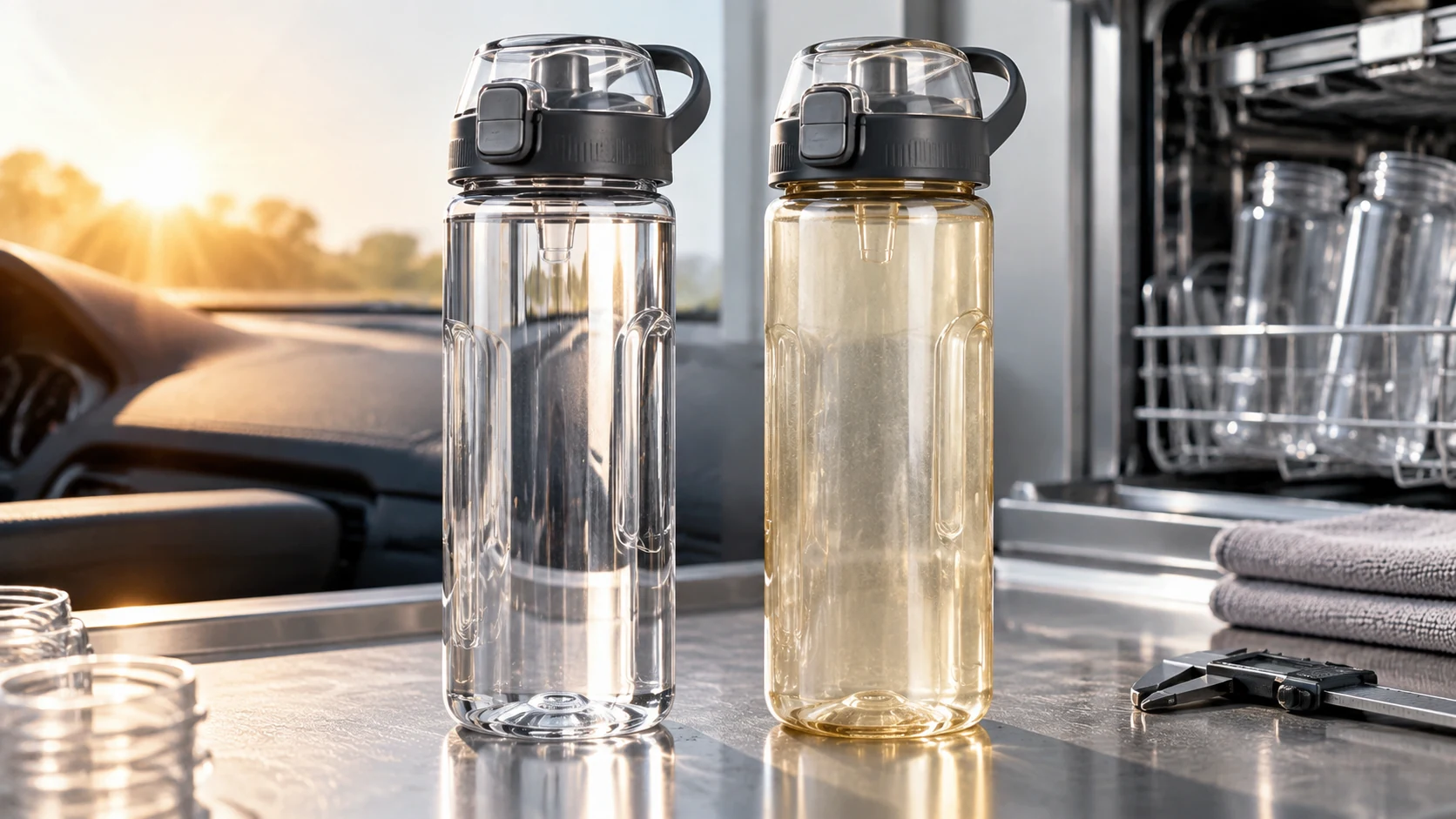
A clear bottle can look very different after months of heat, UV exposure and repeated cleaning. Tritan is designed for strong clarity and durability, but it is not immune to aging. This guide explains why discoloration happens, how buyers can slow it, and which supplier questions help protect a clarity-sensitive bottle program.
- Confirm the exact Tritan resin grade and supplier
- Define UV, heat, cleaning and dishwasher exposure
- Request any finished-bottle aging or UV test summary
What Tritan bottle yellowing actually means
Discoloration in clear plastics can involve oxidation, UV exposure, surface wear and staining. Heat can accelerate aging, while ultraviolet light can damage the polymer surface over time. Coffee, tea and strongly colored sports drinks can also leave residue in scratches that become more visible as a bottle ages. Tritan is an Eastman copolyester family developed for clarity, toughness and chemical resistance, and selected grades are designed for demanding dishwasher environments, but more resistant does not mean immune. For a broader material decision, see the choosing the right bottle material guide.
The four accelerators buyers should control
Dishwasher heat is a common source of repeated thermal and chemical stress, especially when aggressive detergents are combined with water-jet abrasion. Prolonged UV exposure, such as a bottle left on a car dashboard or beside a sunny window, adds cumulative surface damage. Harsh cleaners, concentrated bleach and abrasive pads can attack or scratch the surface. Pigmented drinks can then make those worn areas look darker or more yellow. The key purchasing point is that care conditions should be matched to the exact resin grade, bottle construction and intended market rather than assumed from the word Tritan alone.
How the common clear-bottle materials compare
Tritan is often selected when a brand wants long-lasting, glass-like clarity with a BPA-free copolyester platform. Conventional polycarbonate can also start with strong transparency, but the exact resin and market requirements matter when BPA is a concern. PETG can offer good clarity and forming flexibility but may have different scratch and heat-aging trade-offs. Natural PP is generally more translucent and is commonly chosen where crystal-clear appearance is not the main requirement. The comparison is not a universal performance guarantee: grade, wall thickness, additives, molding conditions and cleaning exposure can change the result. For a side-by-side material guide, see how Tritan compares with PP, PETG and PC.
What actually slows yellowing down
For consumers, mild detergent, careful washing and avoiding prolonged direct sunlight are simple ways to slow visible aging. For buyers, the bigger opportunity is specification control before production. Ask whether the exact resin grade is intended for your cleaning and UV conditions, whether any UV-stabilization approach is part of the compound, and whether the supplier has measured clarity or appearance after accelerated exposure. Also define packaging care instructions instead of promising that every Tritan bottle will remain crystal clear forever. A clear maintenance message can prevent a cosmetic aging issue from becoming an avoidable return.
Questions to put in your RFQ
Ask the supplier which exact resin grade and resin supplier will be molded, whether the compound has UV stabilization for the intended use, whether accelerated aging or UV exposure data exists for the finished bottle, what wall thickness is being quoted, and whether any clarity or appearance commitment has defined limits. These questions test whether the factory understands the complete material system rather than simply repeating a material name. They also create a written reference for sample approval, packaging claims and future reorder checks.
Set realistic care expectations before the order ships
Yellowing is not automatically evidence that a bottle is unsafe, and it should not be treated as proof of chemical leaching without product-specific evidence. However, a bottle with cracks, severe degradation or a persistent odor should be replaced regardless of color. True polymer yellowing from aging is not normally restored by household cleaning; mineral deposits or surface residue may sometimes be improved, but chemical changes in the polymer are different. For brands selling bottles for everyday use, pair honest care instructions with a clear specification and sample-approval record.
How to investigate a bottle that already turned yellow
When a customer sends a yellowed bottle, do not diagnose the cause from color alone. First ask how long the bottle was used, whether it went through a dishwasher, what detergent was used, whether it was stored in direct sunlight, and what liquids were inside it. Compare the returned bottle with an unused bottle from the same production lot if one is available. Check whether the discoloration is uniform through the wall or concentrated at scratches, seams, printed areas or the liquid line. A surface stain can look different from bulk polymer discoloration. Photograph the closure, body and high-wear areas, record the model and lot information, and compare the actual resin declaration with the approved purchase specification. This creates a useful root-cause record instead of turning one customer photo into a blanket conclusion about every bottle in the program.
A simple supplier validation plan before mass production
For a clarity-sensitive private-label program, build a small validation plan before committing to a large order. Approve the exact bottle, lid, resin grade, color and wall thickness first. Then define the exposure conditions that matter commercially: normal hand washing, the dishwasher cycle used by your market, prolonged indoor or outdoor light, and any contact with strongly colored drinks. Ask the supplier which conditions they can test and what measurements they will report, such as appearance, haze, color change or photographs at defined intervals. Keep the test method, sample quantity and acceptance criteria in writing. If the factory has no accelerated-aging data, that is not automatically a failure; it simply means the buyer should avoid making an unsupported lifetime-clarity promise. A controlled sample and clear care statement are more defensible than a generic claim that a Tritan bottle can never yellow.
Separate material aging from staining and surface haze
The phrase yellowing can describe several different visual problems, so the first troubleshooting step is to separate them. A transparent wall that has changed throughout its thickness suggests a different mechanism from a surface film that wipes away or a localized brown mark around scratches. Mineral scale can create haze, while drink pigments can stain worn surfaces. Stress, molding defects or incompatible cleaners can also produce crazing or cloudiness that buyers may describe as yellowing. This distinction matters because changing resin will not necessarily fix a contamination or care problem, while a cleaning change will not reverse a genuine polymer-aging mechanism. When reviewing a complaint, record the location, pattern, cleaning history and production lot before deciding whether the issue is material-related.
What Eastman's published Tritan data supports
Eastman's published Tritan materials describe excellent clarity, chemical resistance, heat resistance and dishwasher durability, and its processing guidance notes that versions of Tritan can use additive packages such as UV. These are material-level references, not proof that a specific XUYI bottle will never discolor under every exposure condition.
Practical next step: Ask the supplier for the exact resin grade, formulation and finished-bottle test conditions. If UV exposure is commercially important, define the exposure method and acceptance criteria instead of treating the Tritan trade name as a lifetime-clarity guarantee.
Primary references
- Eastman Tritan TX1000 copolyester — product attributes and dishwasher durability ↗
- Eastman Tritan copolyester — drying and processing guidelines ↗
External regulations and standards are independent references, not product certification or proof of testing by XUYI. Confirm applicability and the latest rules for the exact product, destination and transaction date.
Clarity-aging questions to resolve before production
Use the same evidence and exposure assumptions when comparing bottle materials, samples and supplier claims.
| Buyer question | What to specify | Why it matters |
|---|---|---|
| Resin identity | Exact resin grade and supplier | Tritan is a material family; grade and formulation affect performance |
| UV exposure | Expected sunlight or outdoor exposure and any stabilization requirement | Cumulative UV exposure can change surface appearance |
| Cleaning | Dishwasher cycle, detergent and hand-washing expectations | Heat, chemicals and abrasion can accelerate visible aging |
| Bottle construction | Wall thickness, finish, color and approved sample | Geometry and molding conditions affect clarity and durability |
| Evidence | Finished-bottle aging or UV test summary where available | Product-specific evidence is stronger than a generic material claim |
Buyer decision criteria, not XUYI certification, published MOQ or guaranteed delivery times. Verify the exact model and market requirements.
Buyer checklist
- Confirm the exact Tritan resin grade and supplier
- Define UV, heat, cleaning and dishwasher exposure
- Request any finished-bottle aging or UV test summary
- Record wall thickness and the approved bottle construction
- Publish care instructions that do not promise permanent clarity
Frequently asked questions
Does yellowing mean a Tritan bottle is unsafe?
Not necessarily. Yellowing is generally an appearance or aging issue and does not by itself prove chemical leaching. A cracked, severely degraded or persistently odorous bottle should be replaced, and any safety claim should be based on the exact product and applicable evidence.
Is Tritan better than polycarbonate for long-term clarity?
Tritan is designed to provide excellent clarity, toughness and chemical resistance, and Eastman publishes grades intended for durable dishwasher use. Exact results still depend on resin grade, molding, wall thickness, additives and exposure conditions, so buyers should compare product-specific evidence rather than assume one material name guarantees a lifetime result.
Can a yellowed bottle be restored?
Surface residue or mineral deposits may sometimes be cleaned, but true UV or oxidation-related polymer discoloration is a material-aging change and is not normally reversed by household cleaning. Prevention and realistic care instructions are more reliable than restoration.
Should a private-label brand mention yellowing in the product listing?
Brands should communicate relevant care instructions honestly, especially when frequent dishwashing or prolonged sunlight is expected. A statement such as hand washing to preserve appearance can set realistic expectations without implying that every Tritan bottle will yellow quickly.
Need a quote for a specific model?
Send the model, expected order quantity, logo requirements and destination market. XUYI can review confirmed material and customization options.
Request a Plastic Bottle Quote →