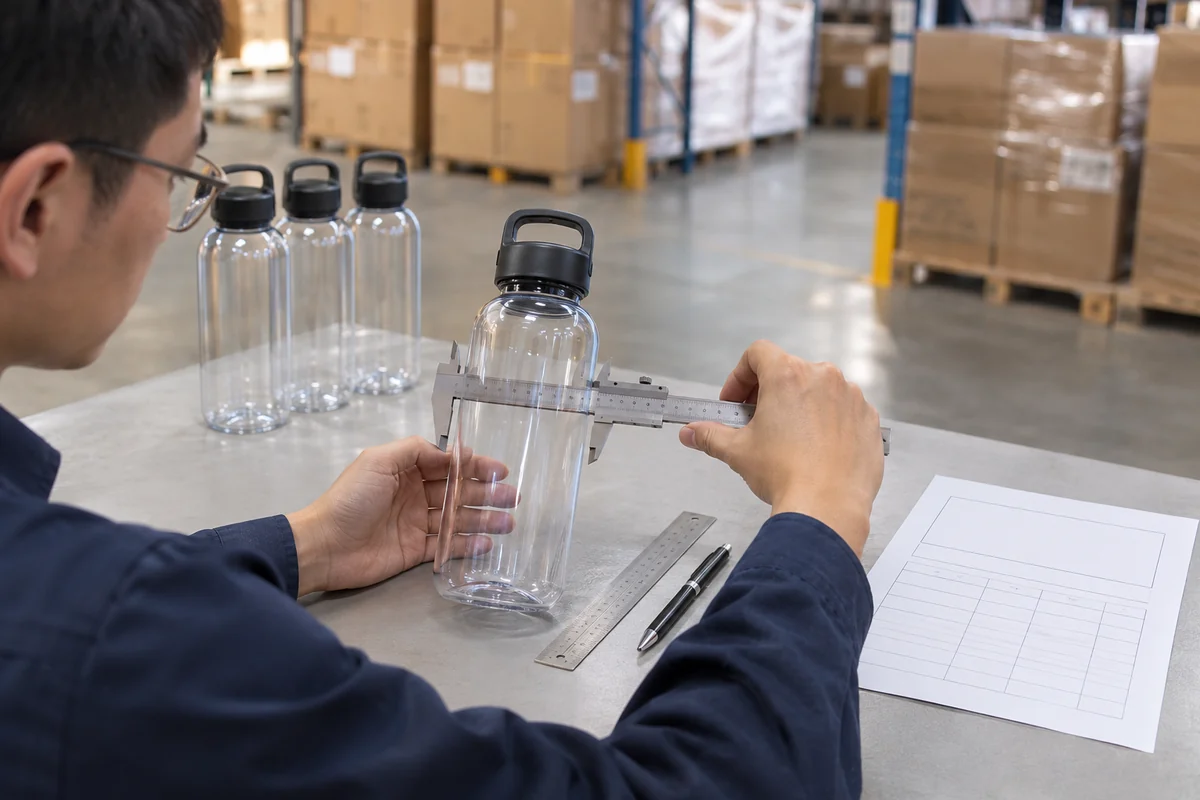
A dimension sheet is useful only when the buyer can connect every measurement to the exact bottle, cap, capacity and production version being quoted.
- Record the exact body, cap, material, color, capacity and drawing revision.
- Write both the confirmed millilitre value and the approximate ounce size class.
- Mark height, widest diameter, base, neck, opening, cap and accessory dimensions.
Start with the exact product identity
Before comparing numbers, freeze the identity of the product the numbers describe. Record the model or SKU, body version, cap version, capacity in millilitres and the reviewed ounce size class, material stated by the supplier, color, decoration and revision date. A dimension sheet for a 500 ml body cannot automatically approve a 750 ml body that uses the same marketing family name. Ask the supplier to show which drawing, mold or sample the sheet belongs to and keep a photo of that sample with the RFQ. If the supplier has both a standard and a custom version, write the difference in the purchase file instead of relying on a filename. This prevents a buyer from comparing a precise drawing with an approximate catalogue image or accepting a replacement part that happens to look similar but has a different neck or base.
Check the measurements that affect fit
Review overall height, maximum body diameter, base diameter, neck outside diameter, opening, cap height and any handle, grip ring or sleeve that changes the envelope. Ask whether each number is measured on the bottle body alone or on the assembled product. For a retail shelf, carton, bicycle cage or vehicle holder, the widest point and usable height matter more than a nominal capacity label. For a refill point or dispenser, the neck and opening may matter more than the shoulder. Mark the critical dimensions on the drawing and compare them with the physical sample using the same reference points. If a number is absent, do not invent a tolerance; ask the factory to identify the measurement method, tool and acceptance range used for production inspection. Use 500ml / 16.9 oz class sports bottle model 2095 as the exact sample identity for the dimension review.
Separate capacity from physical volume claims
Capacity should be written as the factory-confirmed millilitre value, with an approximate or size-class ounce expression when the page is written for overseas buyers. Do not turn an ounce class into an exact conversion or use a rounded capacity to approve a different body. Ask how capacity was measured, whether it is brimful or usable fill, and whether the cap, straw or internal insert changes the usable amount. For a mixed wholesale assortment, create one row per model and record ml, ounce class, height, diameter and cap combination. This gives a retailer a defensible way to compare shelf space and user expectations while keeping the technical source value intact. If the supplier cannot confirm the capacity definition, label the item as requiring confirmation instead of presenting a precise figure the drawing does not support.
Read tolerance notes instead of only nominal sizes
A nominal height or diameter does not tell the buyer how much variation may appear between samples. Look for the drawing's measurement points, reference datums, rounding rules and tolerance notes. Ask which dimensions are critical to fit, sealing, decoration or packaging and which are informational. A cap may seal even when a cosmetic diameter varies slightly, while a small neck or thread change can create a leak or prevent a spare lid from fitting. The buyer does not need to create a factory standard from a blog article; the buyer does need a written method for deciding whether a sample is within the supplier's stated control. Save the approved drawing and marked sample, then require a new review if the mold, resin, cap, process or decoration changes. Use 650ml / 22 oz class PP/PC sports bottle model 2100 as the exact sample identity for the dimension review.
Compare the sheet with a production-intent sample
Use a sample that represents the version being quoted, not a presentation piece selected only for photography. Measure the same points on the agreed sample set and note whether the bottle is empty, dry, assembled and at room temperature. Do not use a visual match as proof of dimension accuracy. Record tool resolution, operator, date and sample identity in the inspection note, while leaving the supplier responsible for its own controlled production method. If the buyer needs a formal capability study, request it separately with the method and population defined. For ordinary wholesale approval, a clear side-by-side record exposes a changed base, taller cap, thicker sleeve or different handle before cartons are printed and the order is released.
Control drawings, artwork and packaging together
Dimension changes often create downstream problems outside the bottle itself. A taller cap can change the inner carton height; a wider base can change the master-carton count; a sleeve can hide a measurement point; and a logo area can move when the shoulder or taper changes. Add the approved drawing revision, artwork proof, color or material note and packaging specification to one purchase-order package. Ask the supplier to identify the owner of each file and the change that would trigger a resample. The goal is not to freeze every cosmetic decision forever; it is to make sure a commercial update cannot silently become an engineering change. This also makes future reorders simpler because the distributor can compare a new sample against the same controlled record instead of a vague product name. Use 1000ml / 32 oz class gradient sports bottle model 2516 as the exact sample identity for the dimension review.
Turn the sheet into an acceptance rule
The final RFQ or purchase order should state the exact model, ml capacity, approximate or class ounce reference, material as confirmed, cap, color, decoration, key dimensions, supplier tolerance notes, sample reference and change-approval rule. State which dimensions are checked at incoming inspection and which documents must accompany a revision. Do not promise a tolerance, MOQ, delivery time or certification unless the supplier has provided and the buyer has approved that fact. Keep an approved sample, the drawing and inspection photos together. When a later batch is received, compare the exact variant and record any deviation before distributing stock. A dimension sheet becomes useful when it helps two different people make the same decision; it is not useful when it is only a decorative PDF attached to an RFQ.
Dimension-sheet decision matrix
Separate identity, measurement method, fit risk and change control.
| Decision area | Buyer check | Safe record |
|---|---|---|
| Identity | Body, cap, material and revision | One exact SKU combination. |
| Measurement | Points, tool, condition and tolerance | Method recorded. |
| Fit | Neck, base, height and widest point | Critical dimensions marked. |
| Documentation | Drawing, artwork and packing | Approved revision attached. |
| Change | Mold, resin, cap or accessory | Resample before release. |
Buyer decision criteria, not XUYI certification, published MOQ or guaranteed delivery times. Verify the exact model and market requirements.
Buyer checklist
- Record the exact body, cap, material, color, capacity and drawing revision.
- Write both the confirmed millilitre value and the approximate ounce size class.
- Mark height, widest diameter, base, neck, opening, cap and accessory dimensions.
- Ask how each dimension is measured and which tolerance notes control acceptance.
- Compare the sheet with a production-intent sample using the same reference points.
- Record tool, operator, date, sample identity and inspection condition.
- Link drawing, artwork, color, decoration and packing revision in the RFQ.
- Define which dimensions affect fit, sealing, decoration or carton planning.
- Require review when mold, resin, cap, decoration or packing changes.
- Attach the approved drawing and sample record to the wholesale order.
Frequently asked questions
Why is a capacity number not enough to confirm bottle fit?
Capacity describes nominal volume, not the bottle's height, base diameter, shoulder shape, neck or cap clearance. A buyer should compare the complete dimensional record with the target shelf, bag, holder or carton.
Which dimensions should a wholesale tolerance sheet include?
List the measurement point, nominal value, permitted tolerance, unit and measurement method for height, body or base diameter, neck and closure interfaces, plus any feature that affects packaging or use.
Is a supplier's nominal measurement enough for approval?
No. Measure the production-representative sample and confirm the supplier's method. Keep the signed drawing or sheet with the approved SKU so future reorders can be compared consistently.
How does a tolerance sheet help with repeat orders?
It gives purchasing, quality and receiving teams one agreed reference. Record any approved change separately rather than silently replacing the old dimension or treating a similar-looking bottle as identical.
Need a quote for a specific model?
Send the model, expected order quantity, logo requirements and destination market. XUYI can review confirmed material and customization options.
Request a Plastic Bottle Quote →