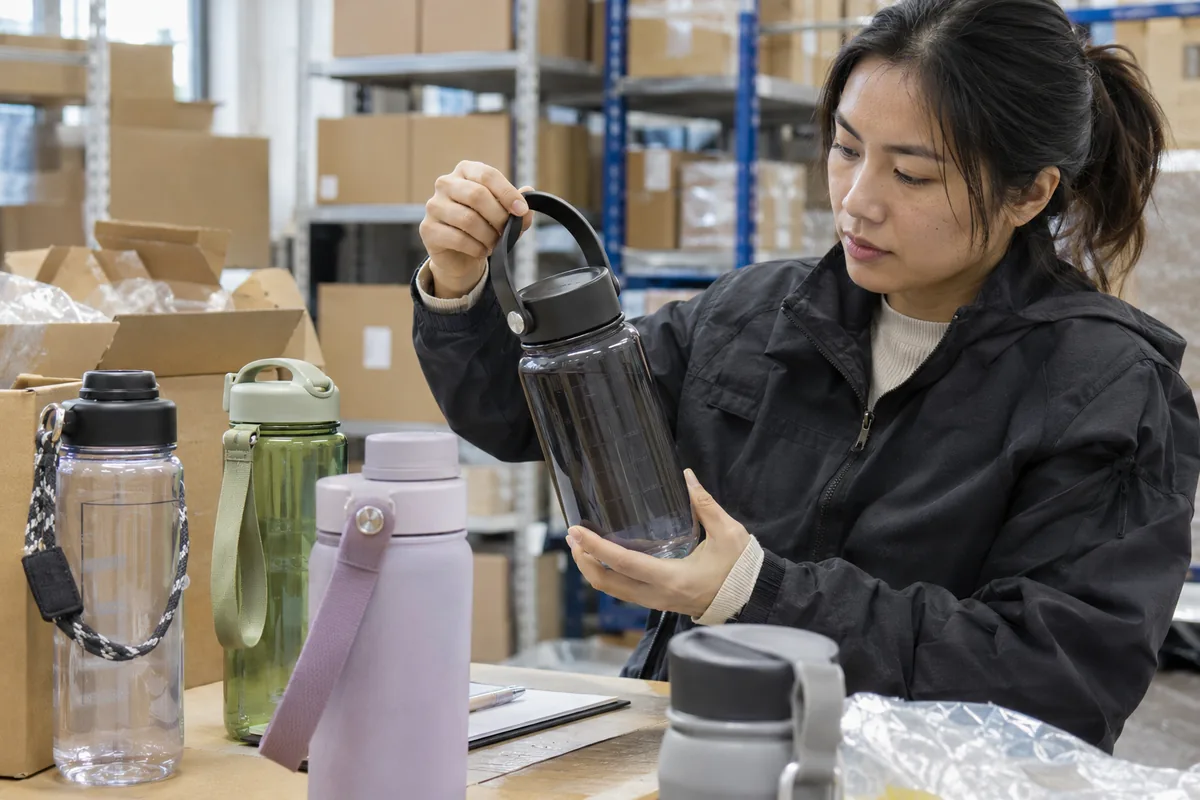
A handle can look secure in a product photo and still fail at the joint, twist under a filled load or feel uncomfortable in daily use. This guide turns a carry-handle review into a repeatable bulk-order decision.
- Record exact body, cap, handle or strap SKU and revision.
- State empty, partial or agreed filled test condition.
- Photograph every attachment point before and after.
Define what the handle must carry
Start with the real use case rather than the marketing name. A short hand loop used for a 500 ml promotional bottle is not tested in the same way as a strap that will hang from a filled 1,000 ml bottle during a gym or outdoor program. Write down who carries the bottle, whether it is empty or filled, how long it stays attached, and whether it is clipped to a bag, placed in a vehicle, or repeatedly lifted from a carton. For the purchase file, record the exact model, cap version, capacity, material, attachment point and approved color. This prevents a supplier from proving one light-use sample while the production order contains a heavier body or a different loop design. The first pass should produce a clear use condition, not an unsupported universal load claim.
Map the attachment points by SKU
Inspect the attachment geometry before pulling on the handle. Check whether the loop is molded into the body, threaded through a separate cap, fixed with a rivet, or joined through a small plastic bridge. Measure the opening and look for sharp flash, thin sections, incomplete welding, loose stitching or a gap that can trap dirt. Photograph the attachment from both sides and mark the inspection point on the sample sheet. If the handle is removable, test the connector and the bottle together; a strong strap attached to a weak cap is still a failed system. Ask the factory to identify the material of each load-bearing part and to keep the neck, cap and handle as one controlled bill of materials. A buyer should approve the actual geometry, not a similar catalog picture. Use an exact sample such as 500ml / 16.9 oz class sports bottle model 2095 when the handle and body are approved together.
Inspect the joint before testing
Run a filled-use test with a repeatable sample condition. Use the same liquid level, cap torque and temperature for every sample, then carry the bottle by the handle for a defined route that represents the buyer's program. Include lifting from a table, placing into a carton, swinging only as the real user would, and setting the bottle down without using the cap as a grip. Record deformation, noise, separation, cap loosening and any visible whitening around the bridge. The point is not to create a laboratory certification; it is to compare the approved sample with later samples under the same practical condition. If the buyer needs a formal load or drop requirement, it must be written into the purchase specification and verified by an agreed test method.
Run a repeatable filled-bottle hold test
Add a repetition and wear check because a handle can pass one pull and still fail after daily use. Repeat the carry cycle with the bottle filled to the agreed level, then inspect the attachment, cap threads, gasket seat and surrounding body. Rotate the handle through its normal range without forcing it past the stop. Look for cracks, stress whitening, elongation, frayed fibers, loose seams or a connector that no longer returns to its original position. Record the number of cycles and the exact failure mode instead of writing only passed or failed. For a promotional order, a short documented sample test may be enough; for a retail or sports program, the buyer should ask for a longer repeatability plan and retain a sealed golden sample for comparison during incoming inspection. Compare the filled-use sequence on 650ml / 22 oz class PP/PC sports bottle model 2100 with the buyer's approved handle condition.
Check twisting, swinging and contact
Material and care instructions affect the handle decision. Confirm whether the body is PP, PC, PETG, Tritan or another specified plastic, and do not infer the material from color or transparency. Food-contact suitability, temperature limits, cleaning instructions and chemical exposure should be checked for the destination market and the exact component combination. A strap or cap made from a different material may need its own declaration or supplier record. Avoid publishing a dishwasher, hot-fill or freezer claim unless the approved model, cycle and test evidence support it. The buyer's technical file should connect the handle, cap, bottle body, decoration and care label to the same SKU so that a late material substitution cannot quietly change the safety or durability result.
Separate comfort from strength
Control the variants that can change the test result. Capacity, body shape, gradient color, logo position, cap color and packaging may look like cosmetic options, but they can change weight, balance, grip and the stress placed on a handle. List every color and capacity intended for the purchase order and state which combinations were sampled. If a logo, sleeve or gift box is added, check that it does not cover the care label or create extra pull on the strap. The supplier should return a marked artwork proof and a variant matrix showing the approved SKU for each combination. This is especially important for wholesale assortments where one approved blue sample is later substituted with a larger, heavier or differently capped version. Review comfort and contact clearance on the larger 1000ml / 32 oz class gradient sports bottle model 2516 before repeating the same strap promise.
Freeze the approved handle version
Release production only after the evidence is easy for another buyer to audit. Keep the approved sample photo, model number, capacity in millilitres and US fluid-ounce class, material declaration, color code, logo proof, test condition, result and carton identification in one record. The purchase order should say that substitutions require written approval and a new sample check when the handle, cap, body, material or decoration changes. At incoming inspection, select cartons by SKU and compare the handle attachment against the retained sample before checking quantity. If a failure appears, quarantine the affected variant, record the batch and ask for a corrective action rather than mixing accepted and unaccepted stock. This workflow gives a B2B buyer a practical trail from RFQ to reorder without pretending that a visual inspection replaces a regulated test.
Handle and strap approval matrix
Separate identity, physical condition, use scenario and change control.
| Decision area | Buyer check | Safe record |
|---|---|---|
| Identity | Body, cap, handle, strap and revision | Approved only for the listed combination. |
| Joint | Eyelet, stitch, rivet, bridge, gap and finish | No visible damage before the use test. |
| Use | Agreed fill level, lift, carry, swing and set-down | Passed the stated buyer sequence. |
| Comfort | Grip, pinch points, glove use and cap access | User context recorded; no universal claim. |
| Reorder | Sample, photos, artwork, packaging and change owner | Repeat the approved revision or re-test. |
Buyer decision criteria, not XUYI certification, published MOQ or guaranteed delivery times. Verify the exact model and market requirements.
Buyer checklist
- Record exact body, cap, handle or strap SKU and revision.
- State empty, partial or agreed filled test condition.
- Photograph every attachment point before and after.
- Check flash, cracks, whitening, loose threads, sharp edges and gaps.
- Repeat the same lift, carry, set-down and inspection sequence.
- Include the sideways pull or swing expected in the sales channel.
- Inspect cap, seal, bottle wall and artwork after handle contact.
- Review finger comfort, glove use and drinking-opening access.
- Keep approved sample and reference photos with the purchase order.
- Require review after any handle, mold, material or cap revision.
Frequently asked questions
Can a bottle handle or strap be assumed to carry the full bottle?
No. The attachment, handle, strap, cap and bottle body form one assembly. Test the offered configuration with the intended filled condition and record the result before making a carrying claim.
What should a wholesale handle test cover?
Check attachment points, stitching or molded features, grip, interference with the lid, repeated handling and the condition after testing. Use the same parts and decoration as the production sample.
Does bottle material alone determine strap durability?
No. Durability also depends on the attachment geometry, strap material, hardware, load path and use conditions. Request evidence for the complete assembly rather than relying on the body resin name.
What belongs in the sample approval record?
Record the exact model, handle or strap parts, filled condition, test method, observed result, artwork or color variant and any care or use limit that must follow the shipment.
Need a quote for a specific model?
Send the model, expected order quantity, logo requirements and destination market. XUYI can review confirmed material and customization options.
Request a Plastic Bottle Quote →