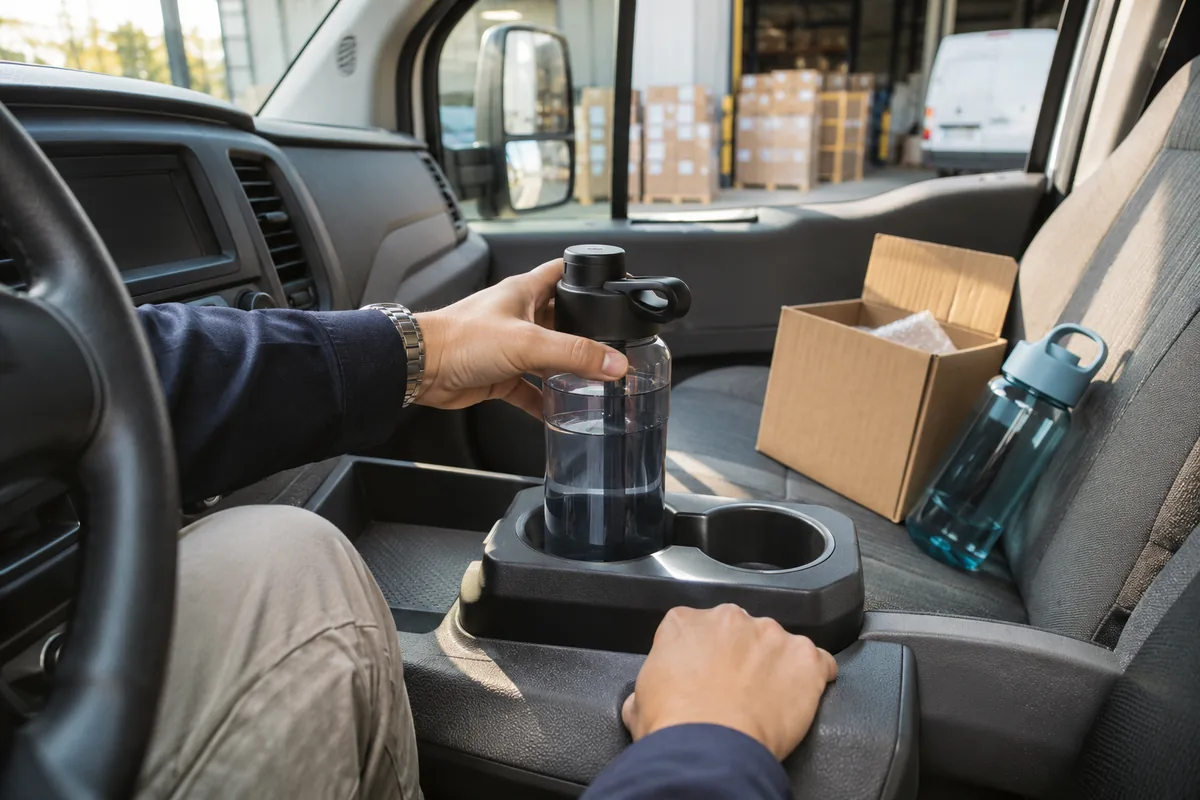
Vehicle cup holders are not a single retail standard. A bottle that fits one console can be too wide, too tall or awkward to remove from another. This guide helps wholesale buyers document a real sample decision.
- Define target vehicle, console or cup-holder use.
- Record exact body, cap, handle, color and revision.
- Measure widest body, base, cap and side features.
Define the target cup-holder use
Start by defining the vehicle use instead of asking whether a bottle is universally car-compatible. Cup holders differ between sedans, vans, trucks, buses and aftermarket consoles, and their openings can be tapered, shallow, flexible or interrupted by inserts. Record the intended vehicle group, the cup-holder location, whether the bottle will be empty or filled, and whether the driver must remove it with one hand. A wholesale buyer should also state the cap style and handle clearance requirement because a bottle can fit the base but still hit the dashboard or a handbrake. The first sample brief should name the exact SKU, capacity in millilitres and ounce class, body material and closure so the fit decision is traceable. Use 500ml / 16.9 oz class sports bottle model 2095 as the exact sample identity when recording the first cup-holder fit result.
Measure the sample without guessing
Measure the bottle at the points that actually enter the holder. Record the base diameter, widest body diameter, taper, height above the holder and any foot, grip ring or seam that changes the profile. Measure the holder opening and usable depth on the target vehicle or fixture, including the tightest section rather than the nominal top diameter. Keep millimetres as the working unit and add an inch reference only for the buyer's convenience. A catalogue dimension may exclude the cap, sleeve or decoration, so compare a production-intent sample with the drawing. If several capacities share one cap, do not assume they share the same vehicle fit; the body shape and center of gravity may change as capacity increases.
Test insertion with the bottle filled
Test stability with a realistic filled condition. Fill the bottle to the agreed level, close it with the approved cap and place it in the target cup holder. Check movement during start, braking, a turn and removal by hand, then inspect whether the body rubs against the holder or whether the cap contacts the console. The purpose is to document fit and stability, not to promise safe use in every vehicle or to replace a vehicle-safety assessment. Record the fixture or vehicle, liquid level, orientation, number of trials and the result for each capacity. If a bottle tips, binds or cannot be removed without squeezing the body, mark the condition and adjust the SKU recommendation before the assortment is quoted. Compare the base, cap and hand clearance of 650ml / 22 oz class PP/PC sports bottle model 2100 with the same target holder.
Check cap, handle and hand clearance
Check the space above the holder as carefully as the base. A flip lid, straw, carry loop or button may need clearance from the dashboard, armrest or console wall. Open and close the cap while the bottle remains in the holder, then remove it using the intended grip. Check that a hand can reach the cap without touching a hot surface or a moving control, and note whether a handle catches on the holder edge. For a retail program, photograph the bottle in the target fixture with the cap open and closed. These simple records make a buyer's fit claim understandable and prevent a supplier from presenting a low bottle-profile sample when the order will use a taller cap or promotional sleeve.
Repeat the test across variants
Consider material, grip and condensation as part of the user experience. PP, PC, PETG, Tritan and other plastics can have different stiffness, surface feel and temperature behavior, so the buyer should confirm the actual material for the approved SKU. A smooth body may rotate more easily in a loose holder, while a textured or sleeved body may bind in a narrow one. Cold drinks can create condensation and a wet base; test whether the bottle remains stable and whether moisture reaches the console. Do not turn a single vehicle observation into a universal safety statement. State the tested bottle, holder condition, care instruction and limitations in the product information used for wholesale sales.
Keep listing language narrower than the evidence
Build a fit matrix before selecting the retail assortment. List each capacity, body diameter, cap height, handle or strap option, color, logo treatment and intended vehicle or fixture. Mark each combination as tested, not tested, or not recommended, and link the result to a sample photo and model number. If a smaller bottle fits widely but the larger version is unstable, sell them as different use cases rather than using one generic compatibility claim. This matrix also protects replenishment: a new cap supplier, mold revision, sleeve, base ring or decoration can change the profile even when the product name stays the same. Any change should trigger a focused recheck before the listing or purchase order is updated. Keep the larger 1000ml / 32 oz class gradient sports bottle model 2516 claim limited to the holder and sample condition actually checked.
Lock the approved sample for reorders
Release the order with a controlled sample and clear receiving checks. The RFQ should include the target holder dimensions, bottle measurements, fill condition, cap and handle clearance, material, capacity in ml and ounce class, sample photos and the buyer's acceptance decision. At pre-shipment or incoming inspection, check the model and variant against the approved sample and measure the critical base and height points on a reasonable carton sample. Keep the test vehicle or fixture reference with the purchasing record, and describe the result as fit checked for the stated condition rather than universally compatible. This gives a B2B buyer a repeatable path from a conversational long-tail question to a defensible wholesale specification.
Vehicle cup-holder fit matrix
Record tested geometry and use condition instead of turning one sample into a universal claim.
| Decision area | Buyer check | Safe record |
|---|---|---|
| Target | Vehicle, console, holder range and use scenario | Checked for the stated context only. |
| Geometry | Body width, base, cap, handle and side features | Dimensions recorded on the approved sample. |
| Stability | Base seating, upright position and filled condition | Stayed stable in the stated test. |
| Access | Hand, lid, spout, strap and control clearance | Removal path recorded; limitations visible. |
| Change | Mold, material, cap, color or decoration revision | Re-test before changing the listing. |
Buyer decision criteria, not XUYI certification, published MOQ or guaranteed delivery times. Verify the exact model and market requirements.
Buyer checklist
- Define target vehicle, console or cup-holder use.
- Record exact body, cap, handle, color and revision.
- Measure widest body, base, cap and side features.
- Test empty and the buyer's agreed filled condition.
- Check base seating, upright stability and removal with the intended hand.
- Review cap, hinge, strap, spout and console-control clearance.
- Repeat the method across every listed capacity and variant.
- Keep fit observations separate from safety, spill and temperature claims.
- Attach photos, dimensions and sample identity to the order record.
- Recheck after any mold, material, cap or decoration change.
Frequently asked questions
Will one reusable bottle fit every car cup holder?
No. Vehicle cup holders vary in diameter, depth, taper and surrounding clearance. Test the complete production-representative bottle in the target vehicles before using a fit claim in wholesale listings.
What should a buyer measure during a cup-holder fit check?
Record the bottle base diameter, overall height, lid and handle clearance, filled stability, removal grip and any contact with the vehicle controls. Name the vehicle and holder tested with the result.
Does a mounted product photo prove compatibility?
No. A photo illustrates a use context but does not verify the exact SKU, fill state or every vehicle holder. Use a signed physical sample and a documented test set.
What should be frozen before a wholesale reorder?
Freeze the exact bottle, cap, seal, dimensions, color, decoration and packaging configuration. A lid or body change can alter clearance even when the catalog model name stays similar.
Need a quote for a specific model?
Send the model, expected order quantity, logo requirements and destination market. XUYI can review confirmed material and customization options.
Request a Plastic Bottle Quote →