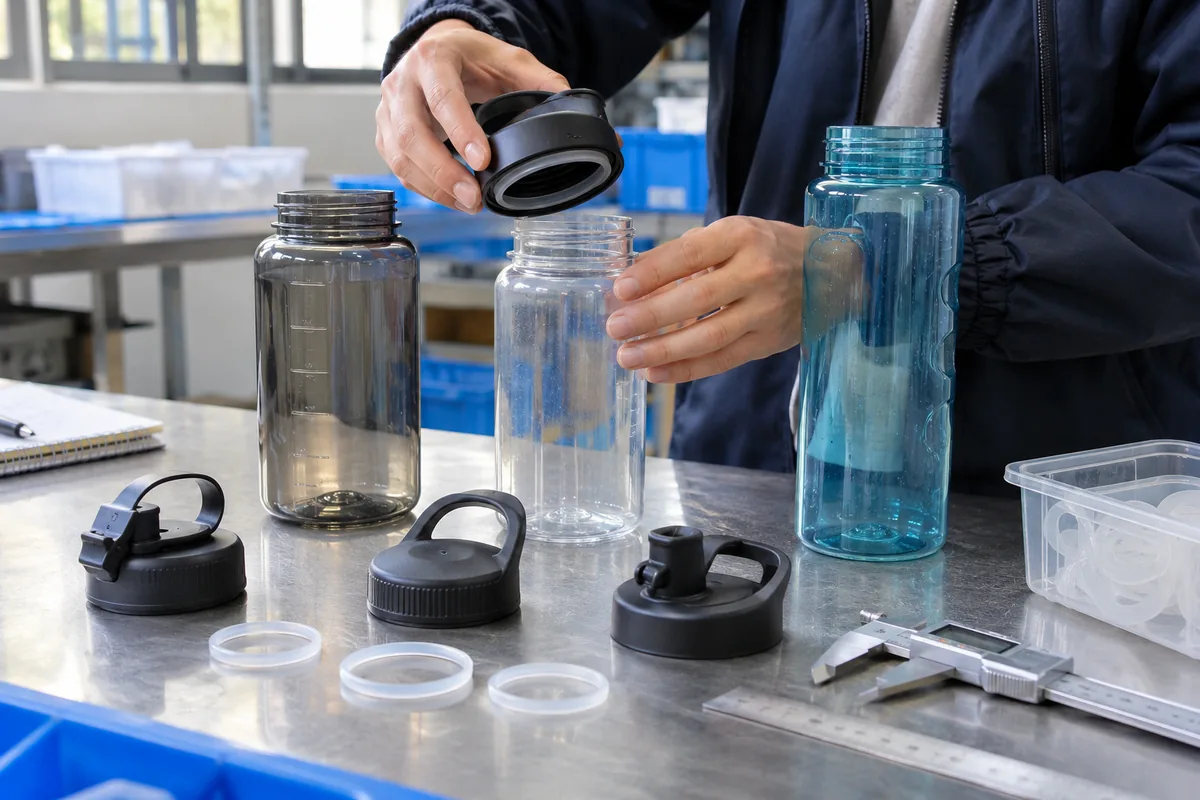
Two bottles can look similar and still require different caps. This wholesale buyer guide explains how to verify neck, thread, seal and function before promising cross-SKU compatibility to a customer or retailer.
- Define compatibility as attachment, seal, function, cleaning and intended-use performance.
- Record exact body SKU, cap SKU, capacity, material and neck family.
- Inspect thread start, profile, pitch, sealing land, gasket and cap skirt.
Define what “fits” means
A cap that screws onto a bottle is not automatically a compatible replacement. For procurement, compatibility should cover the neck finish, thread profile, thread start, sealing surface, gasket or liner, opening diameter, cap skirt, tamper feature, handle clearance and the way the bottle is used. Capacity alone does not identify a neck. Two bottles can both be 500ml while using different neck families, and two bottles with the same outside diameter can have different thread pitch or sealing geometry. Start the buyer record with a simple decision: does the cap physically attach, seal under the intended pressure, open and close as expected, survive the agreed handling and remain compatible with the decoration and packaging plan? If the answer is not verified on the actual body and cap, describe the part as a candidate, not a universal replacement.
Map every body, neck and SKU
Create a compatibility map with one row per exact body and one row per exact cap. Record model number, capacity, body material, neck finish, thread description, opening, gasket material, cap material, straw or valve, color, tooling and approved sample. The listed 550ml Plastic Sports Water Bottle model 2501 may be a starting product row, but it must not be used to infer compatibility with every other capacity. Add photographs of the bottle mouth and cap underside, plus a simple drawing or measured reference supplied by the factory. When a buyer uses a family name such as sports bottle, ask for the exact SKU because family labels are commercial categories, not dimensional standards. This map makes a reorder safer and lets the buyer explain why a visually similar lid was not substituted. Use 550ml plastic sports water bottle model 2501 as one map row; confirm the neck and cap with a sample, not capacity alone.
Check thread, finish and sealing surfaces
A visual check is not enough for a threaded closure. Inspect the neck finish, thread start and direction, pitch or profile, sealing land, gasket seat, cap skirt and any vent or valve opening. The measurement method must be repeatable: use the same reference points, tool and sample condition, and record whether the measurement is nominal or observed. Do not publish a tolerance unless the factory has confirmed it for the component family. A cap can appear tight while the gasket is not seated, or it can seal at room temperature and leak after the bottle is squeezed, inverted or warmed. Photograph the interface after assembly and record the number of open-close cycles or leak checks used by the buyer. The purpose is not to make a lab certification claim; it is to show that the specific body-cap pair was reviewed under the intended use.
Test function, cleaning and user clearance
Compatibility is also functional. Fill the bottle with the intended liquid or a safe test medium, close it with the candidate cap, invert it, shake it and inspect the seal using the buyer's agreed method. Check that the cap opens without excessive force, the thread does not cross-start, the gasket stays in place and a straw, valve or carry handle does not collide with the body. Run the care or cleaning routine that the buyer will communicate, then look for swelling, odor retention, trapped liquid, deformation or a loose seal. Do not assume that a cap that fits a small bottle will be comfortable on a large bottle or that a replacement part can inherit the original care claim. Record the test conditions, not only the result, and separate a factory sample check from a market-specific compliance decision.
Prove cross-size compatibility with physical samples
A cross-size claim should be earned by testing each approved combination, not by placing a cap on a product photograph. The listed 1000ml Plastic Sports Water Bottle model 2514 can be one row in a test plan, while the 1200ml Plastic Sports Water Bottle model 2517 can be a second row; the buyer should confirm the actual neck and cap rather than assume that capacity predicts the interface. Test body, cap, gasket and any accessory together, then document attach, seal, opening, clearance, appearance and packing. If one cap works on two bodies but the decoration, handle or retail box does not, record compatibility at the component level and the commercial limitation. A buyer-friendly result says exactly which SKUs were verified and which remain untested. Test 1000ml plastic sports water bottle model 2514 as one specific combination; do not infer compatibility for other SKUs without physical samples.
Control spare parts and reorder records
Once a combination is approved, give the part a controlled identity. Record cap SKU, body SKU, gasket or valve version, color, supplier drawing, approved sample photograph, carton packing and change owner. Keep a small retained sample from the approved combination and use the same reference at incoming inspection. When a supplier offers a replacement, compare the new part against the record and require a new sample if thread, seal, material, color or tool changes. A replacement lid is not interchangeable merely because it has the same external appearance. This record also helps sales answer a retailer's question without promising that one spare part fits every bottle family. The practical benefit is fewer mixed cartons, fewer leak complaints and a more predictable reorder. Record 1200ml plastic sports water bottle model 2517 with the approved cap, gasket and tooling versions for a controlled reorder.
Set a pre-production and incoming check
Before mass production, inspect a defined sample of every approved body-cap combination and keep the result with the purchase order. At incoming inspection, check identity, thread engagement, seal seating, opening and visible damage using the same sequence as the approval sample. If a component is outsourced, include the component supplier and revision in the record. Escalate any mismatch before packing rather than asking the warehouse to sort visually similar parts later. Use careful language in catalogs: say compatible with the listed SKUs and verified sample conditions, not fits all sizes. A controlled compatibility matrix is useful to procurement, customer service and content teams because it turns an informal factory memory into a maintainable D1 record that can survive a reorder or a new market request.
Wholesale bottle-cap compatibility table
Treat compatibility as a verified relationship between exact components, not as a capacity label.
| Check area | What to verify | Buyer-safe wording |
|---|---|---|
| Identity | Body SKU, cap SKU, gasket, valve and revision | Compatible with the listed verified combination. |
| Interface | Neck finish, thread, seal, opening and skirt | Fits this body after sample review. |
| Function | Open, close, invert, shake, clean and carry | Passed the stated buyer test conditions. |
| Cross-SKU | Each body-cap combination and limitation | Do not generalize to untested sizes. |
| Reorder | Retained sample, drawing, color and change owner | Repeat the approved component revision. |
Buyer decision criteria, not XUYI certification, published MOQ or guaranteed delivery times. Verify the exact model and market requirements.
Buyer checklist
- Define compatibility as attachment, seal, function, cleaning and intended-use performance.
- Record exact body SKU, cap SKU, capacity, material and neck family.
- Inspect thread start, profile, pitch, sealing land, gasket and cap skirt.
- Use repeatable reference points and record observed versus nominal measurements.
- Test opening, closing, inversion, shaking and the buyer's cleaning routine.
- Check straw, valve, handle, grip, decoration and packaging clearance.
- Verify every cross-SKU combination with a physical body and cap sample.
- Assign controlled identities to cap, gasket, valve and tooling revisions.
- Keep an approved retained sample and use it at incoming inspection.
- Describe compatibility only for verified SKUs and conditions.
Frequently asked questions
Can one cap fit every bottle with the same capacity?
No. Capacity does not define the neck finish, thread, seal or opening. Verify the exact body-cap combination.
Is outside diameter enough to confirm a replacement lid?
No. Thread profile, pitch, sealing surface, gasket, cap skirt and clearance also matter. Use repeatable measurements and a physical sample.
How should a buyer make a cross-SKU compatibility claim?
List the exact verified SKUs, components and test conditions. Do not use a universal phrase when other combinations are untested.
What should happen when a supplier changes a cap or gasket?
Update the component revision, compare with the retained approved sample and require a new fit and leak review before reorder.
Need a quote for a specific model?
Send the model, expected order quantity, logo requirements and destination market. XUYI can review confirmed material and customization options.
Request a Plastic Bottle Quote →