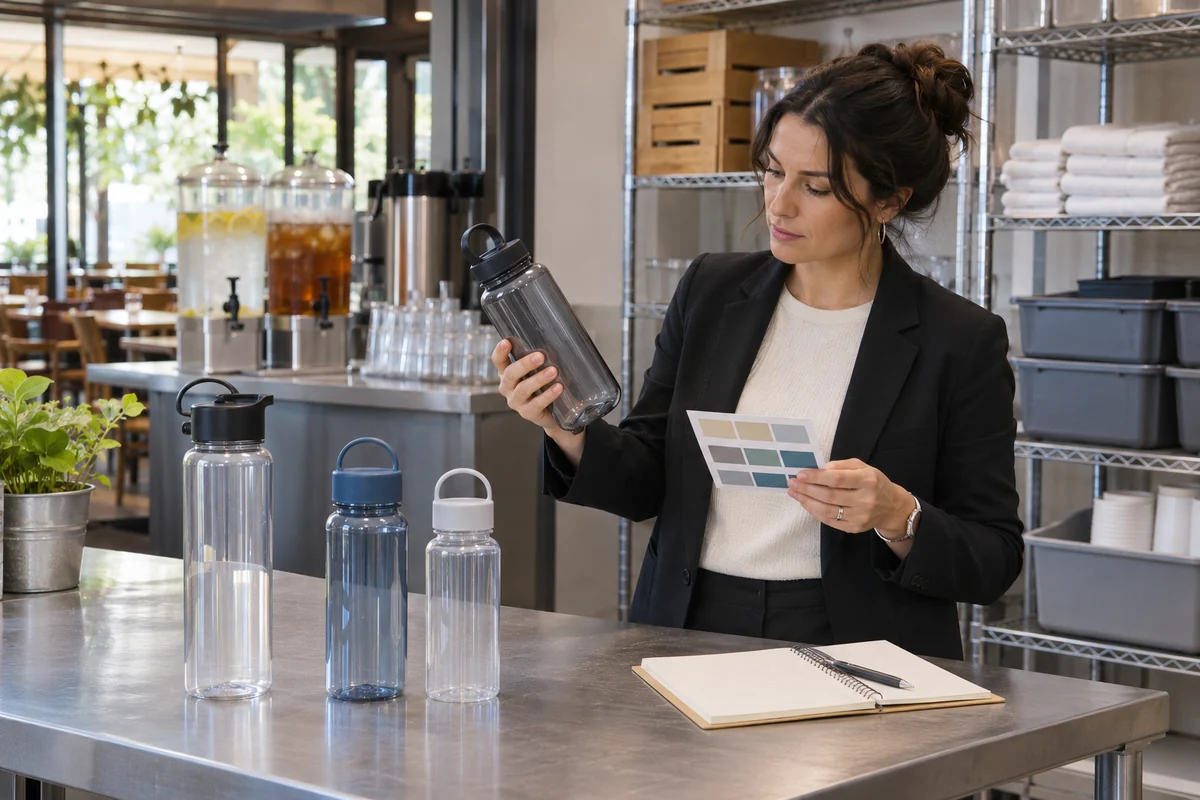
Restaurant groups need more than a bottle that looks good in a product photo. A multi-location beverage program must connect the intended guest or staff use, capacity, lid handling, logo permissions, store-level replenishment and the evidence required before a buyer makes a claim. This article is a practical B2B framework. The cover is an AI-generated editorial illustration of a procurement review, not a customer order, factory record or exact XUYI model.
- Map demand by restaurant location, user group and date.
- Separate staff, guest, catering and event quantities.
- Test complete body, lid, seal and removable parts.
1. Separate guest, staff and event demand before choosing a bottle
A restaurant group may need reusable bottles for staff hydration, catering teams, guest welcome packs, loyalty promotions or a seasonal beverage campaign. These are different buying jobs even when the same logo appears on every bottle. Start with a simple demand map by location, user group, service date and expected replacement cycle. Separate confirmed stores from planned openings and separate everyday use from a one-off event. This prevents a central buyer from selecting one capacity and one lid for every venue without checking how the bottle will be carried, washed, stored and handed out. It also gives the supplier a clearer brief: quantity by variant, delivery destination, artwork owner and target date. Use the restaurant scene in this article as context only; it is not evidence that a particular chain, kitchen or customer has approved a product.
2. Match capacity and lid handling to real shifts
Capacity should follow the way a bottle is used during a shift, not a round number chosen because it sounds familiar. Ask whether the bottle needs to fit an apron pocket, a service station shelf, a refrigerator door, a tote or a staff locker. Check the opening method, carry loop, seal components and cleaning routine with the people who will use it. A larger bottle may reduce refill frequency but take more space in a welcome kit or retail display; a smaller format may be easier to distribute but create more replenishment work. Confirm the actual body, cap, seal and removable parts in a complete physical sample. Do not promise leakproof, hot-liquid or dishwasher performance unless the exact assembled product has supporting evidence for the intended market.
3. Compare a small reference range instead of forcing one SKU everywhere
A useful first quotation often compares a small, documented range rather than asking a supplier to price an undefined “custom bottle.” For example, a procurement team can request one compact option, one everyday staff option and one larger event option, then compare the complete sample, dimensions, lid behavior, decoration area and carton presentation. XUYI model 2511 · 550 ml / 18 oz class can be opened as a 550 ml / 18 oz class catalog reference, while XUYI model 2512 · 750 ml / 24 oz class provides a 750 ml / 24 oz class reference. Treat those pages as starting points for a physical sample review, not proof that either model suits every store. Keep the comparison table focused on evidence the buyer can verify: assembled height and diameter, component list, decoration method, approved color and destination-market documentation.
4. Control brand colors, artwork versions and location variants
Multi-location programs become difficult when “the logo” actually means several restaurant brands, seasonal marks, franchise approvals or different artwork files. Name one owner for brand approval and one owner for purchase approval. Record the artwork version, print area, color reference, permitted logo use and the exact bottle and lid combination. If locations need different colors, list them as separate variants rather than hiding the split in a note. Request a physical or otherwise approved proof before production and keep the signed version with the purchase record. A supplier should not be asked to infer a color from a low-resolution screenshot. Separating brand, model, lid, color and carton labels reduces the risk of a correct logo being printed on the wrong configuration.
5. Compare landed cost and replenishment by location
A unit price alone cannot answer whether a restaurant program is commercially sensible. Compare the same model, component set, decoration process, packaging level, quantity split and destination on every quotation. Add sample costs, artwork or setup charges when applicable, individual packing, cartons, freight, duties and local distribution. Then model the cost of a replacement unit and the time needed to replenish a single location, not just the initial central shipment. Ask how mixed colors or capacities affect the quote and whether each variant needs its own minimum quantity. XUYI model 2403 · 1,000 ml / 32 oz class is a 1,000 ml / 32 oz class catalog reference that may be useful for a larger-use comparison, but capacity class is not a substitute for a signed sample and a confirmed specification. Keep all commercial assumptions visible in the approval record.
6. Ask for the right evidence without making unsupported claims
Before a restaurant group publishes product claims, ask for documentation that matches the exact bottle assembly and destination market. The relevant evidence may cover the body material, cap material, seal, decoration contact area, packaging or other requirements defined by the buyer and local rules. Do not turn a general material statement into a guarantee for a complete product, and do not present an editorial image as proof of a factory, customer, certification or performance test. A clear sourcing file should identify the requested model, revision, components, evidence received, open questions and who approved the wording. This approach helps marketing, purchasing and operations use the same facts and makes a later reorder easier to audit.
7. Inspect the first shipment and turn store feedback into a reorder rule
When the first shipment arrives, inspect cartons from more than one part of the delivery rather than checking only the first box. Compare model, lid, color, logo version, quantity and visible condition against the approved sample and purchase record. Separate damage or mismatched variants before distribution. Ask a small group of stores to record practical feedback: opening and closing, cleaning, storage, staff acceptance, guest response and replacement reasons. Do not convert a few comments into a universal performance claim, but use repeated observations to improve the next order. A controlled reorder record should carry forward the approved sample, artwork version, variant quantities, receiving notes and any changes requested by the restaurant group.
Buyer checklist
- Map demand by restaurant location, user group and date.
- Separate staff, guest, catering and event quantities.
- Test complete body, lid, seal and removable parts.
- Confirm the capacity and physical storage space for each use.
- Assign owners for artwork, brand approval and purchase approval.
- Record each color, logo version and carton variant separately.
- Compare total delivered cost, not just unit price.
- Request evidence for the exact assembled product and market.
- Inspect cartons from more than one shipment position.
- Keep the approved sample and receiving record for reorders.
Frequently asked questions
Should one bottle format be used across every restaurant location?
Not automatically. Compare the actual users, storage, cleaning and delivery needs by program, then decide whether one documented range or several variants are justified.
Can a product photo prove that a bottle is suitable for restaurant operations?
No. A photo can illustrate a context, but the complete physical sample, component details and market-appropriate evidence must support the buying decision.
How should a restaurant group compare supplier quotes?
Ask suppliers to quote the same model, capacity, lid, color split, decoration, packaging, quantity and destination, then add setup, freight, duties and distribution assumptions.
What should be retained for a repeat order?
Keep the approved assembled sample, exact model and variant list, artwork version, quote assumptions, receiving inspection and store-level feedback.
Need a quote for a specific model?
Send the model, expected order quantity, logo requirements and destination market. XUYI can review confirmed material and customization options.
Request a Plastic Bottle Quote →