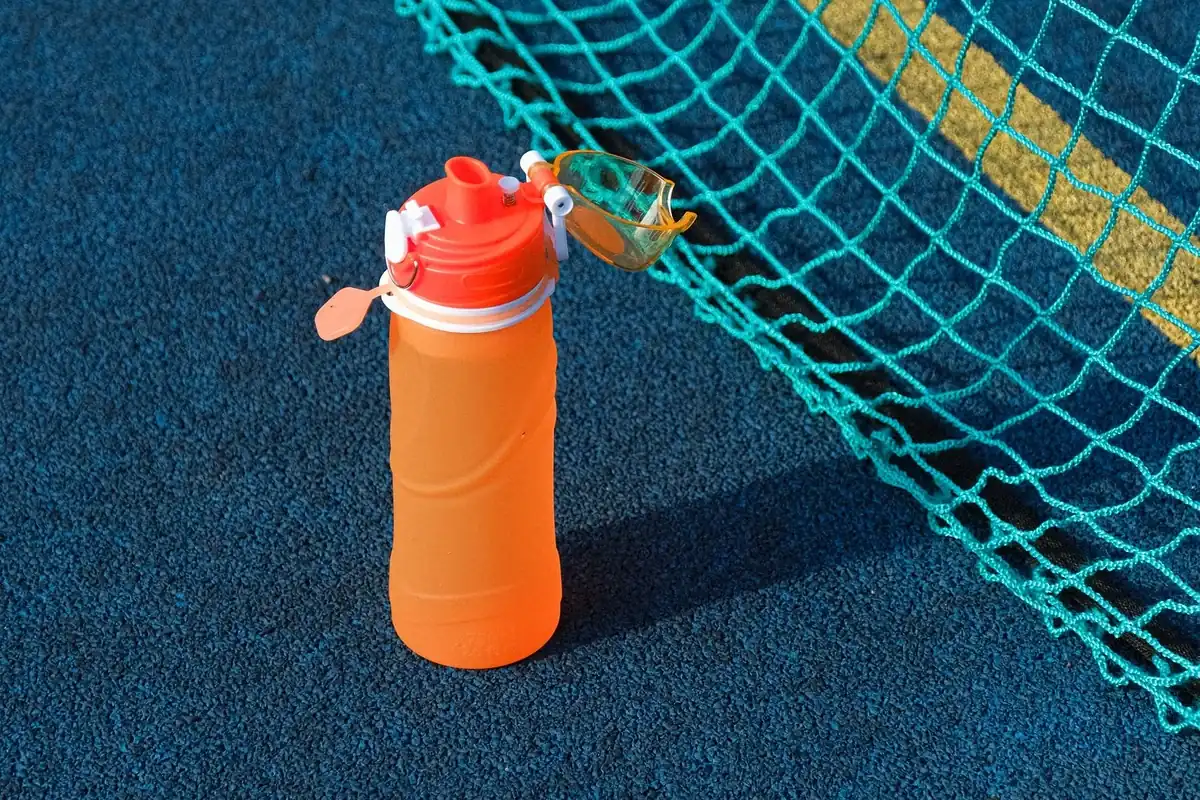
Tennis-club purchasing mixes member welcome kits, junior lessons, league teams and tournaments. A reliable reusable-bottle order needs planned issue quantities, court-side handling checks, personalization controls and a clear replacement process. The licensed photograph shows a generic bottle beside a sports-court net, not an exact XUYI model, customer or performance test.
- Confirm: Forecast quantities by league roster, coach group and event
- Confirm: Check real court-side storage and safe player identification
- Confirm: Approve complete bottles using club training scenarios
Forecast quantities by league roster, coach group and event
Separate the season's fixed team roster, junior coaching intake, temporary tournament volunteers and optional pro-shop resale. Do not estimate demand from the entire club membership if many players already own bottles. List group issue dates, confirmed numbers, planned spare units and the person responsible for each batch. Identify whether family or adult programs use distinct artwork and whether each coach issues one bottle per player or manages spare stock. Create a documented demand sheet separating confirmed quantities from forecasts, owner approval and a small justified buffer. Recheck the allocation when the first pilot closes; a named buyer should sign off the quantities before deposits or artwork commitments. Review model 2030 as a physical reference before approving this variant; confirm its current product record rather than assuming the same material or cap configuration.
Check real court-side storage and safe player identification
Assess where bottles may safely stand during training: designated bench areas, equipment shelves or coach-managed carriers, not paths of play or hazardous court edges. Use a physical example to test stability, naming areas and how sweaty hands hold and open a closure. The illustrative court-side bottle is not a XUYI SKU test and does not establish universal court suitability. Ask staff to approve the storage and naming procedure before an order is placed. Record a physical fit-and-use test including the assembled closure and all removable parts. Keep a dated sample photograph, the exact revision and a clear list of assumptions that were not yet proven by supplier documents. Review model 2059 as a physical reference before approving this variant; confirm its current product record rather than assuming the same material or cap configuration. Consider XUYI model 2306-transparent only as a catalog reference at this decision stage; request its complete physical sample and verify the configuration rather than inferring it from the editorial photograph.
Approve complete bottles using club training scenarios
Bring a fully assembled sample to a supervised lesson rather than judging only an online size graphic. Compare the cap, opening, body grip, removable pieces, carrying arrangement and cleaning instructions. Request evidence for the actual plastics, closures and intended destination-market compliance. Avoid unverified claims that the bottle is leakproof after being thrown into a kit bag or that it tolerates hot washing. Record the approval and the sample revision. Use real measurements, signed labels and multiple sample units instead of applying one generic fit claim to all variants. The shop or operator must approve how bottles are stored and handled in its actual environment.
Separate junior-team logos from member retail merchandise
Keep team coaching bottles, one-off tournament gifts and items sold in the pro shop as separately approved variants. Obtain written rights for the tennis club emblem and permission for any sponsor logo. Do not personalize junior bottles with unnecessary personal information; use a simple agreed player-label method where permitted. Verify printed color and placement on a real bottle and keep a sign-off for each artwork revision and team color. Review care instructions and relevant documented material information for the whole configured bottle. Claims such as dishwasher safe, BPA free or guaranteed leakproof require evidence appropriate to the precise model and destination. Consider XUYI model 2401 only as a catalog reference at this decision stage; request its complete physical sample and verify the configuration rather than inferring it from the editorial photograph.
Schedule distribution, cleaning and lost-bottle replacements
Name a kit coordinator for delivery to each coaching group and prevent unlabeled mixed cartons. Define whether bottles remain player-owned, who maintains spare caps and how the club handles lost or damaged units. Include an accessible cleaning and drying instruction based on the verified assembly rather than untested claims. A reusable bottle does not replace the venue's own responsibility to provide safe drinking water during organized activities. Obtain written art rights, inspect a printed sample and reconcile each carton label to an approved model and variant. Any changed logo, color, cap, packaging or supplier component needs a controlled purchase specification update.
Compare landed team-kit costs, artwork and split deliveries
Ask bidders for the same bottle configuration, number of caps, printing, individual or bulk packing and destination schedule. Include sample freight, setup, split-carton handling, import charges and contingency stock. Compare the full delivered cost per issued player kit, not only the lowest unit price. Tie production approval to the signed sample and print proof, and leave a realistic buffer before a tournament or seasonal registration deadline. Compare equivalent offers on total delivered usable-unit cost and explicitly identify freight responsibility, carton quantities, duty assumptions, sampling and make-good procedures. Document the date at which a revised quote must be approved. Consider XUYI model 2505 only as a catalog reference at this decision stage; request its complete physical sample and verify the configuration rather than inferring it from the editorial photograph.
Inspect club deliveries and preserve an exact reorder specification
On arrival, count each carton against the club allocation plan and verify logos, colors, lids, seals and visible damage using several sample cartons. Quarantine mismatched items and agree the remedy before distributing kits. Retain the approved drawings, actual physical sample, supplier quote, shade reference and count by coaching group. Repeat orders should preserve this approved configuration unless the supplier submits a changed assembly for renewed review. At receipt, take a documented sample from several cartons, reconcile missing and damaged units and hold discrepancies separately. Preserve the approved sample, purchase order, receiving record and quality notes for a compliant repeat order.
Tennis Club Team Bottle Procurement buyer approval matrix
Sign off each decision with actual physical samples, records and responsible people; never infer SKU performance from the contextual photograph.
| Stage | Required evidence | Buyer sign-off |
|---|---|---|
| Forecast quantities by league roster, coach group and event | Demand forecast and allocations | Approve quantity |
| Check real court-side storage and safe player identification | Signed complete physical sample | Approve assembled sample |
| Approve complete bottles using club training scenarios | Actual fit and use notes | Approve scenario |
| Separate junior-team logos from member retail merchandise | Assembly care and material evidence | Approve procedure |
| Schedule distribution, cleaning and lost-bottle replacements | Logo proof and variant quantities | Approve artwork |
| Compare landed team-kit costs, artwork and split deliveries | Equivalent landed-cost quotation | Approve commercial terms |
Buyer decision criteria, not XUYI certification, published MOQ or guaranteed delivery times. Verify the exact model and market requirements.
Buyer checklist
Use these points when comparing a factory sample, artwork approval and purchase quotation.
- Confirm: Forecast quantities by league roster, coach group and event
- Confirm: Check real court-side storage and safe player identification
- Confirm: Approve complete bottles using club training scenarios
- Confirm: Separate junior-team logos from member retail merchandise
- Confirm: Schedule distribution, cleaning and lost-bottle replacements
- Confirm: Compare landed team-kit costs, artwork and split deliveries
- Confirm: Inspect club deliveries and preserve an exact reorder specification
- Retain printed sample sign-off
- Reconcile carton allocation by variant
- Record reorder approval and lead-time evidence
Frequently asked questions
Is the cover photograph an exact XUYI SKU or buyer installation?
No. It is a commercially licensed illustrative scene; the physical XUYI product assembly must be approved separately.
Can this category be advertised as leakproof, food-safe or dishwasher-safe without tests?
No. Obtain appropriate evidence for the exact bottle, cap, material and destination market before making a product claim.
Does one bulk quote cover all logo and color combinations?
Not necessarily. Confirm permissions, variant-level minimum quantities, physical proofs, setup charges and carton labeling.
What evidence should be retained before reordering?
Keep signed assembly samples, exact SKU, caps and seals, artwork version, quotes, carton records and receiving discrepancies.
Need a quote for a specific model?
Send the intended model, material requirements, expected order quantity, artwork and destination market. We will review the options for that exact product rather than assume one specification fits every bottle.
Request a Plastic Bottle Quote →Related Buying Guides
 How Should Soccer Academies Buy Reusable Team Water Bottles in Bulk?
Soccer Academy Bottle Procurement wholesale guide: exact bottle samples, licensed logo proofs, realistic allocation, packaging, landed prices and reorder controls.
 How Should Cycling Clubs and Race Organizers Buy Branded Water Bottles in Bulk?
Cycling race water bottle wholesale guide: rider allocation, cage fit, printing, packing by start wave, delivery dates and receiving inspection.
 How Should Summer Camp Operators Buy Reusable Water Bottles for Group Programs?
A wholesale sourcing guide for summer-camp drinkware: age groups, name labels, cap selection, camp artwork, replacement parts, shipment planning and inspection.