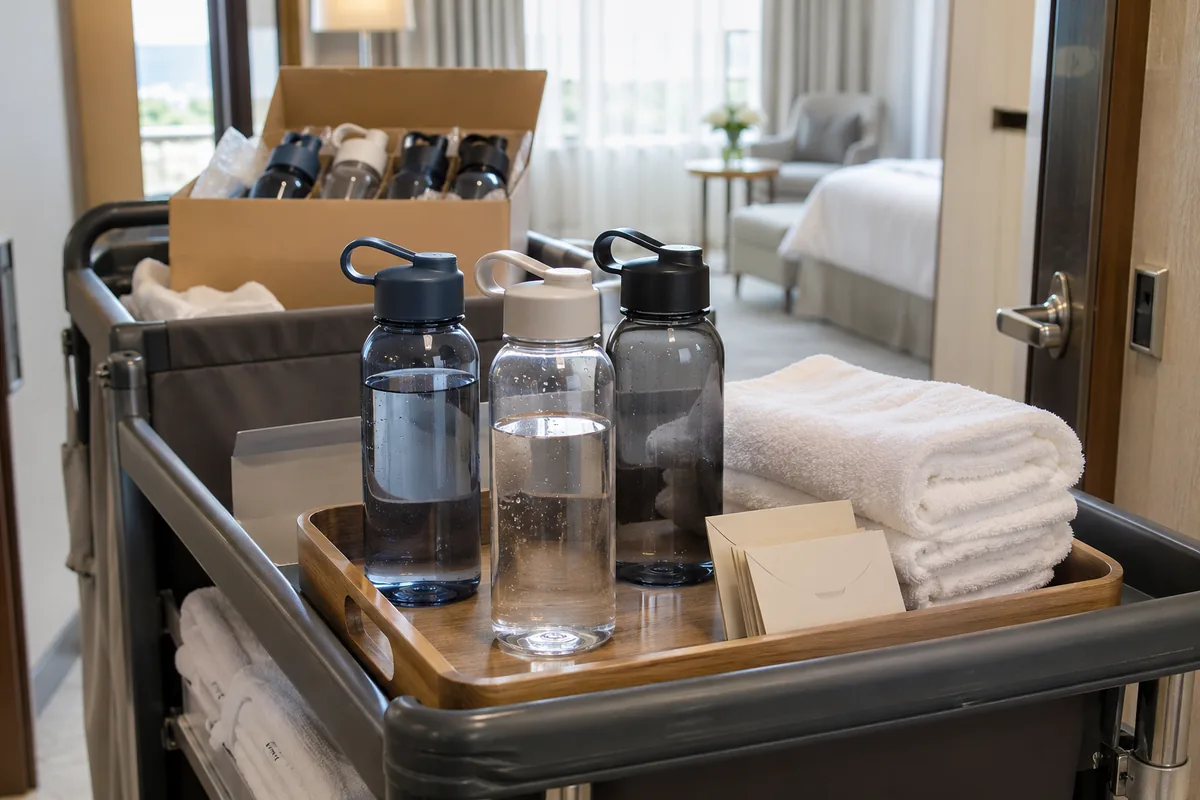
Hotel welcome kits look simple to guests, but the bottle inside them must survive room turnover, storage, transport and repeat ordering. This guide turns those buyer decisions into a usable factory brief.
- Use case: room welcome tray, refill station, conference kit or extended-stay room
- Capacity: confirm 500ml (about 16.9 US fl oz) or 750ml (about 25.4 US fl oz) against the room setup
- Exact body, lid and seal materials recorded by SKU
Start with the guest-use case, not a catalog favorite
A hotel welcome-kit bottle is handled in a different way from a gym bottle or a retail shelf item. The buyer should first map where it will be placed, how long it may remain in a room, whether guests are expected to refill it, and whether housekeeping will remove or replace it after checkout. A compact 500ml bottle can suit a single welcome tray, while a 750ml option may make more sense for extended-stay rooms, conference packages or properties that promote refill stations. The important point is to define the use case before asking a supplier to quote a model. Ask for the finished dimensions, filled weight, cap clearance and carton quantity so the bottle fits the tray, minibar, cupboard and housekeeping trolley. A clear use case also prevents the common mistake of selecting a visually attractive bottle that is too tall for the room setup or too heavy for a multi-room delivery cart. Review model 2030 as a physical reference before approving this variant; confirm its current product record rather than assuming the same material or cap configuration.
Confirm the plastic material and contact-use documentation
Hotels often want a reusable plastic bottle because it is lighter and easier to pack than glass, but “plastic” is not a sufficient specification for a purchase order. Request the exact material for the bottle body, lid and any soft seal, then ask which part is intended for contact with drinking water. Depending on the model, buyers may compare PP, PET or a clear copolyester-style option; the supplier should confirm the actual material for the selected SKU rather than treating a marketing name as a specification. Ask which market documentation can be provided, what test scope it covers and whether the test sample matches the production material and color. If the hotel plans to use hot drinks, a dishwasher program or flavored beverages, put that use case into the RFQ and ask for a written suitability response. Never turn a general material possibility into an unsupported claim about a finished model. Review model 2059 as a physical reference before approving this variant; confirm its current product record rather than assuming the same material or cap configuration.
Treat cap hygiene and leak control as room-service requirements
A bottle in a guest room is judged by the experience of opening it, carrying it and putting it beside a laptop or travel bag. The cap should be easy to grip, the drinking opening should be easy to clean, and the seal should be checked with the exact bottle, lid and decoration combination. Ask the factory to explain the closure components, whether the seal is removable, how the cap is cleaned before packing and which leak test is used. A flip lid, screw cap and carry loop can all work, but they create different cleaning and replacement questions. Request sample testing in the same orientation that guests will use, including a filled-and-inverted check and a short transport simulation. If the hotel will refill bottles on site, also confirm the neck opening, refill workflow and spare-cap availability. These details are more useful than a generic “leakproof” word in a catalog title.
Plan private-label decoration around the guest experience
A hotel may want a small logo, a property color, a destination line or a neutral co-brand treatment. The buyer should decide whether the decoration must survive hand washing, repeated handling and storage against towels or amenity boxes. Ask the supplier to show the decoration method on the same body shape and surface finish, not on a different sample. Confirm the printable area, minimum artwork line width, color references, proofing process and whether the logo changes the unit packing method. A restrained mark often looks more premium than an oversized print, especially when the bottle is used as part of a welcome tray. Keep the final artwork, approval date and sample photo together with the purchase record. If a hotel group has multiple properties, define which elements are fixed and which can change by property so later reorders do not create unplanned color or logo variations.
Specify individual packing, carton labels and delivery points
The bottle is not purchased in isolation; it arrives as part of a hotel operating process. State whether each piece needs an individual bag, paper insert, barcode, property label or protective divider. Confirm the inner-carton quantity, master-carton quantity, carton dimensions, gross weight and pallet or container loading assumptions before the price is finalized. A buyer supplying several hotels should also list the delivery points, carton marks and whether mixed property versions are allowed in one shipment. These details affect warehouse receiving and room-setup labor even when the bottle itself is unchanged. Ask for a packing photo and a carton label sample before mass production. If the order is split between a central distribution center and individual properties, request separate packing scenarios so the supplier does not quote one carton plan and deliver another.
Use a signed sample to connect the room standard with factory QC
A sample is useful only when the approval record is specific. Record the model, body material, color, lid version, logo artwork, dimensions and packing method, then keep photos of the approved sample. Test the cap opening, drinking feel, seal, surface finish, odor after normal washing and the way the bottle sits in the welcome tray. If the hotel has a quality manual, translate the relevant points into measurable checks: visual defects, color tolerance, logo position, cap fit, carton count and label accuracy. Ask the factory how those checks are sampled during production and what happens when a result is outside the agreed range. Do not approve a clear body and later order a gradient body without a new review; color and surface changes can alter the visual result and the decoration process.
Build a reorder plan before the first hotel delivery
A successful welcome-kit program is usually repeated by season, property opening or conference calendar. Before placing the first order, define the forecast period, minimum reorder quantity, expected lead-time checkpoints, spare units and the information required for a repeat quote. The factory should receive the approved model identity rather than a vague description such as “the black hotel bottle.” Keep one purchase record with the SKU, capacity in ml and approximate US fl oz class, material confirmation, color, decoration file, packing instruction and destination. If the hotel may add properties later, ask how the same body and cap can be repeated and which elements would require a new sample. A small internal buffer can protect room operations, but it should be based on actual occupancy and replacement data rather than an arbitrary percentage. The goal is a repeatable supply brief that a new buyer can understand without reopening every decision.
Hotel welcome-kit sourcing decision matrix
Use the matrix to organize a quote request; it is a buyer planning tool, not a certification or delivery guarantee.
| Decision | What to confirm | Why it affects the hotel |
|---|---|---|
| Capacity | 500ml / 16.9 fl oz or 750ml / 25.4 fl oz class | Tray fit, guest use and carton weight |
| Body material | Exact resin or copolyester specification | Cleaning, clarity and documentation |
| Closure | Cap, seal, opening and carry loop | Leak control and housekeeping workflow |
| Decoration | Artwork, print area and proof | Brand consistency across properties |
| Packing | Piece bag, inner carton and master carton | Receiving and room setup labor |
| Reorder | Approved model identity and change control | Repeat supply without specification drift |
Buyer decision criteria, not XUYI certification, published MOQ or guaranteed delivery times. Verify the exact model and market requirements.
Buyer checklist
- Use case: room welcome tray, refill station, conference kit or extended-stay room
- Capacity: confirm 500ml (about 16.9 US fl oz) or 750ml (about 25.4 US fl oz) against the room setup
- Exact body, lid and seal materials recorded by SKU
- Closure cleaning, seal and filled-inversion test agreed
- Artwork proof approved on the same bottle surface
- Individual packing and carton quantities confirmed
- Carton labels and multi-property delivery marks supplied
- Sample approval record includes color, logo, dimensions and cap version
- Production QC checks mapped to the hotel receiving process
- Reorder brief preserves the approved model instead of a generic product name
Frequently asked questions
Is 500ml or 750ml better for a hotel welcome kit?
Choose from the room layout and refill plan. A 500ml bottle is easier to place on a compact tray; a 750ml bottle can provide more usable volume for extended stays or refill-led programs. Confirm the filled height, weight and carton impact with the exact model.
Can a hotel order custom colors and logo printing on plastic bottles?
Usually a factory can discuss custom colors and decoration options, but the final result depends on the selected plastic, surface, artwork and order quantity. Request a decorated sample or proof on the same SKU before approving mass production.
What should the hotel test before approving the bottle?
Test the complete set: body, lid, seal, decoration and packing. Check opening, carrying, leakage when inverted, cleaning access, odor after normal washing, logo position, carton count and whether the bottle fits the guest-room tray.
How can a hotel avoid problems on repeat orders?
Keep a controlled approval record with model, capacity, approximate oz class, material, color, cap, artwork, packing and destination. Ask the supplier to confirm that the repeat order uses the same approved identity before production.
Need a quote for a specific model?
Send the model, expected order quantity, logo requirements and destination market. XUYI can review confirmed material and customization options.
Request a Plastic Bottle Quote →